Martin Buren
President #8 • Democratic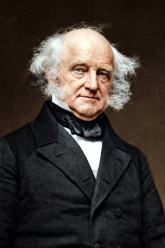
Summary
Positive
Van Buren’s greatest achievement was his successful avoidance of war with Great Britain during a period of extreme vulnerability. His prudent refusal to annex Texas and his careful management of British relations displayed a statesmanship that prioritized the Union over his own popularity.
Negative
Van Buren’s presidency marks the darkest chapter of Indian Removal. His administration’s efficiency in ethnic cleansing stands as his most significant moral failure, particularly with the forced removal of the Cherokee people known as the Trail of Tears.
Basic Information
| Full Name | Martin Buren |
|---|---|
| Party | Democratic |
| Term | Mar 4, 1837 - Mar 4, 1841 |
| Lifespan | 1782–1862 |
| Vice President(s) | Richard M. Johnson |
| Prior Office | 8 Vice President of the United States |
Education
| Degree | Unknown |
|---|---|
| Studies | Law |
Election Results
| Election Year(s) | 1836 |
|---|---|
| Primary Opponent(s) | William Henry Harrison |
| Popular Vote | 764176 (50.8%) |
| Electoral Votes | 170 / 294 |
The Complex Legacy of Martin Van Buren: From Politics to Panic
The Complex Legacy of Martin Van Buren: From Politics to Panic
A New Kind of Politician
Martin Van Buren served as the eighth President of the United States from 1837 to 1841, but his journey into politics was anything but typical for a president. Born on December 5, 1782, in Kinderhook, New York, Van Buren was the first president born a citizen of the United States—and he came from modest beginnings. His father was a farmer and tavern keeper, and his early education was limited, heavily influenced by his Dutch heritage.
Unlike the founding fathers who held military prestige or colonial aristocracy, Van Buren was the product of a political machine, learning the ropes of governance and public sentiment at his father's tavern, where he mingled with travelers and politicians. It was here that he cultivated the people skills crucial for his future political career.
Climbing the Political Ladder
Van Buren's political ascent was methodical. He began his career as a clerk for a Federalist lawyer, which sharpened his debating skills and established his opposition to centralized authority. He then moved to New York City, where he engaged more deeply with the rough-and-tumble nature of local politics, eventually becoming a successful attorney.
By the time he entered state politics, he was an adept organizer and became a significant figure in the formation of the Albany Regency, a political organization that focused on party discipline and strategy rather than charismatic leaders. This foresight led to the establishment of modern political campaigning.
The Election of 1836: A Test of New Strategies
Running for president in 1836, Van Buren positioned himself as the successor to Andrew Jackson, aiming to maintain the Democratic Party's power amid growing opposition from the nascent Whig Party, which sought to undermine him by splitting their votes among multiple candidates. Despite these challenges, he won decisively but faced a divided political landscape, reflecting the increasing tensions of sectionalism and identity in America.
The Presidency: Challenges and Triumphs
Van Buren’s presidency began amid economic turmoil marked by the Panic of 1837, a financial crisis triggered by years of speculation and the reckless lending practices of state banks. The downturn resulted in widespread unemployment and the failure of many banks—a situation made worse by Van Buren's commitment to minimal government intervention. He rejected the idea of a national bank or federal bailouts, insisting the government should focus on maintaining financial conservatism.
Instead, his administration advocated for the Independent Treasury system, which aimed to keep government funds separate from the banking system to safeguard against future crises. This decision was controversial and faced intense opposition, yet it laid the groundwork for future fiscal policies.
A Delicate Hand in Foreign Affairs
While his domestic agenda struggled, Van Buren's foreign policy showed a careful balance. He was faced with several international crises, including tensions with Great Britain over Canadian rebellions and disputes over borders. Van Buren exhibited restraint, choosing neutrality which helped avoid a costly war. His management during the Caroline Affair, in which a British attack on a supply ship had incited American anger, demonstrated his commitment to peace—a politically unpopular but strategically wise decision.
The Controversies: Civil Rights and Scandals
Despite his governance, Van Buren’s presidency was marred by controversies, particularly surrounding civil rights. He oversaw the implementation of the Indian Removal Act, which led to the forced relocation of Native American tribes in what became known as the Trail of Tears. This marked one of his most significant failures, as thousands of Native Americans suffered from exposure and disease during their forced march westward.
Further complicating matters were allegations of corruption and extravagance. For instance, he was mocked as living lavishly during a time of economic hardship—a narrative fueled by political rivals during the election of 1840. Notably, the “Gold Spoon” oration exaggerated his lifestyle, further damaging his reputation as a man of the people.
A Political Legacy
As Van Buren left office in 1841 after a single term, his legacy was mixed. He successfully advanced the principles of political organization and party systems, laying the groundwork for modern political campaigns in America. However, his failure to mitigate economic collapse and effectively manage the moral crises surrounding slavery and Native American rights left a complex mark on his presidency.
His adaptability and innovative political strategies, alongside his notable failings, paint Van Buren as a deeply human figure in the annals of American history—a man striving to balance ideals against the harsh realities of governance.
Conclusion
Martin Van Buren may not be a household name today, but his presidency offers invaluable lessons on the power of political organization and the consequences of economic policy. Ultimately, he was a man of his time — facing the tensions of a growing nation grappling with identity and governance, leaving behind a legacy that shaped the political landscape in ways still felt today.