John Quincy Adams
President #6 • Democratic-Republican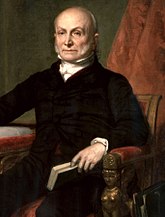
Summary
Positive
Adams's presidency laid the intellectual and infrastructural groundwork for the modern American state, achieving significant progress in infrastructure with investments in canals and roads, and expanding U.S. commercial relations through reciprocity treaties.
Negative
Adams's presidency was marked by political naivety, as his refusal to build a political machine left him vulnerable, and his signing of the Tariff of Abominations inflamed sectional tensions, leading to a significant backlash.
Basic Information
| Full Name | John Quincy Adams |
|---|---|
| Party | Democratic-Republican |
| Term | Mar 4, 1825 - Mar 4, 1829 |
| Lifespan | 1767–1848 |
| Vice President(s) | John C. Calhoun |
| Prior Office | 8 United States Secretary of State ((1817–1825)) |
Education
| Degree | Bachelor of Arts |
|---|---|
| Studies | Unknown |
Election Results
| Election Year(s) | 1828 |
|---|---|
| Primary Opponent(s) | Andrew Jackson |
| Popular Vote | 113122 (30.9%) |
| Electoral Votes | 84 / 261 |
| Voter Turnout | 57.3% |
John Quincy Adams: A Legacy of Vision and Controversy
The Legacy of John Quincy Adams: A Presidency of Promise and Controversy
A President Out of Time
John Quincy Adams served as the sixth President of the United States from 1825 to 1829, but his time in office is often depicted as a paradox. Despite being one of the most qualified individuals to ascend to the presidency—having been a diplomat, legislator, and a member of one of America’s founding families—Adams struggled to achieve his ambitious vision for the nation. He was a man with grand ideas, often stymied by a political landscape that was shifting dramatically.
Adams’ presidency can be seen as both a time of potential and frustration. His tenure is frequently characterized by political historians as a struggle against a divided mandate, a hostile Congress, and the emergence of Jacksonian populism that favored the common man over the elite.
Background: The Making of a Statesman
John Quincy Adams was born on July 11, 1767, in Braintree, Massachusetts. His father, John Adams, was the second President of the United States. Growing up in a politically active household, young Quincy was groomed for leadership from an early age. At just ten years old, he accompanied his father to Paris during the American Revolution, and by the time he was fourteen, he was already working as a secretary to a U.S. envoy in Russia.
Adams’ education included a degree from Harvard, where he later became a professor of rhetoric. His diplomatic career was extensive; serving as the U.S. Minister to several nations, he played a crucial role in shaping American foreign policy under multiple administrations. Perhaps his most notable diplomatic achievement was his authorship of the Monroe Doctrine, which declared the Americas off-limits to further European colonization.
Electing Controversy: The Election of 1824
Adams’ ascent to the presidency was mired in controversy. The election of 1824 was highly contentious, featuring four major candidates: Adams, Andrew Jackson, William H. Crawford, and Henry Clay. Despite Andrew Jackson receiving the most popular and electoral votes, he failed to secure a majority, leading to a contingent election in the House of Representatives.
There, Adams make a deal with Clay, who became his Secretary of State, which enraged Jackson's supporters and led to the term “Corrupt Bargain.” While Adams’ election underscored a significant political shift, it marred his presidency from the outset, fracturing his mandate and undermining his authority.
A Visionary Leadership
In his inaugural address, Adams set out a bold vision for the country, promoting ambitious internal improvements that included a national university, infrastructure projects, and scientific endeavors. However, he faced a divided Congress. His proposals were often labeled as overreaches by opponents who viewed them as a violation of states' rights.
Domestic Policy: The American System
Adams pushed for what he called the “American System,” which meant protective tariffs, a national bank, and federally funded internal improvements. He advocated for a network of roads and canals to encourage economic growth and unify the nation. Although many of his proposals faced fierce opposition, such as the Chesapeake and Ohio Canal, which he famously broke ground for himself, he did manage to secure some infrastructure accomplishments during his term.
The tension between national interests and regional loyalties made it difficult for Adams to effectively implement his policies. Despite significant investment in public works, his initiatives were seen as unconstitutional by many, adding to the political discord.
Economic Downturn and Tariff Controversy
Adams also faced significant economic challenges, including the Panic of 1825. A financial crisis led to a recession that fueled discontent among those who saw him as detached from the struggles of ordinary Americans.
In 1828, the Tariff of Abominations was passed, raising duties on goods and igniting fury in the South, particularly South Carolina. This poorly timed legislation further deepened Adams' unpopularity, showcasing his struggles in navigating a rapidly changing political climate driven, in part, by the regional economic differences of the day.
Controversies and Political Battles
Adams’ presidency was not just marked by policy failures but also by personal scandals and controversies that shaped his public image. From accusations regarding the purchase of a billiard table to baseless claims about his moral character during the 1828 election, he became the subject of relentless attacks by Jacksonian opponents that depicted him as an elitist.
Perhaps most damaging was his inability to effectively respond to a series of politically weaponized accusations that painted him in a negative light, ultimately playing a role in his defeat in the following election.
The Election of 1828: A Defining Loss
The election of 1828 marked a decisive shift in American politics, emphasizing the emergence of a more populist approach to governance epitomized by Jackson. Voter turnout skyrocketed as political engagement expanded, showing a public eager for change.
Jackson decisively defeated Adams, leading to an overwhelming loss for the sitting president, who only managed to secure New England as his stronghold. This was not only a personal loss but a sign of transitioning power dynamics in the American political landscape.
Legacy: A Mixed Assessment
Today, John Quincy Adams is viewed through a complex lens. His presidency is marked more by what could have been than by the successes of an active agenda. His moral stances against slavery and his post-presidency advocacy for civil liberties stand out as elements of his legacy beyond the tumultuous years he spent in the White House.
After his presidency, Adams returned to public service as a Congressman, where he fought for the rights of Native Americans and abolition, earning him the title “the Old Man Eloquent.” His later life showcased his commitment to the principles he had long espoused, leaving a mixed but significant legacy in American history.
Conclusion
John Quincy Adams was a president focused on building a better future for America, but timing and political realities conspired against him. While his direct presidential achievements may not have revolutionized the nation as he envisioned, his life's work in diplomacy, infrastructure, and moral leadership laid important groundwork that would resonate in future administrations.
Adams' story is one of vision and resilience, a testament to the challenges faced by those who aspire to serve a nation navigating the currents of democracy.