George Walker Bush
President #43 • Republican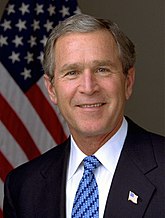
Summary
Positive
Bush’s presidency is marked by significant achievements such as the President’s Emergency Plan for AIDS Relief (PEPFAR), which saved millions of lives, and the No Child Left Behind Act, which established accountability in education. His leadership post-9/11 is credited with preventing further large-scale attacks on U.S. soil.
Negative
Bush faced criticism for the intelligence failure regarding Iraq's weapons of mass destruction, the chaotic response to Hurricane Katrina, and the collapse of his Social Security reform plan. These issues significantly damaged his reputation and legacy.
Basic Information
| Full Name | George Walker Bush |
|---|---|
| Party | Republican |
| Term | Jan 20, 2001 - Jan 20, 2009 |
| Lifespan | Born 1946 |
| Vice President(s) | Dick Cheney |
| Prior Office | 46 Governor of Texas ((1995–2000) ) |
Education
| Degree | Master of Business Administration (MBA) |
|---|---|
| Studies | History |
George W. Bush: A Complex Legacy of Leadership and Controversy
George W. Bush: A Complex Legacy of Leadership and Controversy
George W. Bush served as the 43rd President of the United States from 2001 to 2009. His presidency was marked by pivotal decisions during some of the most critical moments in recent American history. Here's a closer look at his journey, achievements, and some of the controversies that shaped his legacy.
Early Life and Background
Born on July 6, 1946, in New Haven, Connecticut, George W. Bush came from a prominent political family. He is the son of George H.W. Bush, the 41st President of the United States. Growing up in a politically active environment, Bush attended prestigious schools like Phillips Academy and later earned a Bachelor of Arts degree in History from Yale University in 1968. His academic performance was average, yet he was known for his social skills and leadership roles, including serving as president of his fraternity.
After college, Bush enlisted in the Texas Air National Guard, avoiding active duty during the Vietnam War, which would later draw scrutiny. He eventually graduated from Harvard Business School in 1975, making him the only U.S. President to hold an MBA. This business background significantly influenced his approach to governance, favoring efficiency and decisive action.
Path to Power
Bush's pre-presidential career featured a mix of business ventures and political endeavors. His early years in the Texas oil industry were marked by financial challenges, but he leveraged his family's connections to establish Arbusto Energy, an independent oil company. Over the years, he navigated through a series of business ups and downs, eventually becoming a celebrity as the managing partner of the Texas Rangers baseball team, connecting himself to the wider Texas community.
His political journey began in earnest when he was elected Governor of Texas in 1994 by defeating the popular incumbent Ann Richards. As governor, he emphasized a “compassionate conservatism” philosophy that focused on education reform, health care initiatives, and tort reform, sharing a collaborative approach with Democrats in the Texas legislature.
The 2000 Presidential Election
Bush's ascent to the presidency culminated in one of the most contentious elections in U.S. history against Democratic candidate Al Gore in 2000. After a dramatic vote count in Florida, which was ultimately decided by just 537 votes, the Supreme Court intervened in Bush v. Gore, effectively handing the presidency to Bush. He took office with a minority of the popular vote, prompting debates about his legitimacy and mandate.
Major Accomplishments
Post-9/11 Leadership
Bush's presidency took a significant turn following the September 11 attacks in 2001. His response reshaped U.S. foreign policy and homeland security. The launch of the Global War on Terror, including the invasions of Afghanistan and Iraq, sought to eliminate perceived threats and promote democracy globally. These actions, while initially popular, would become sources of contention later in his presidency.
Key domestic achievements during his first term included:
- Tax Cuts: Enacted significant tax relief through the Economic Growth and Tax Relief Reconciliation Acts, aimed at stimulating the economy post-9/11.
- No Child Left Behind Act: Introduced federal accountability measures for schools, mandating standardized testing to track student performance across various demographics.
- Medicare Modernization Act: Expanded Medicare to include prescription drug coverage.
- Homeland Security Creation: Established the Department of Homeland Security to enhance national security and manage U.S. responses to threats.
Second Term Challenges
Bush's second term began with renewed political capital following his re-election in 2004 amidst the backdrop of the Iraq War. He emphasized his administration’s successes in national security and political stability, but faced challenges, including:
- Ineffective Reconstruction in Iraq: Planning for post-war stability was inadequate, leading to a prolonged struggle with insurgency and instability.
- Economic Challenges: The latter years of his presidency were marred by the Great Recession, making his second term defined by economic crisis management. His administration's Troubled Asset Relief Program (TARP) sought to stabilize the financial system but sparked considerable debate due to its bailout nature.
Controversies and Scandals
Bush’s presidency was not without serious controversies. Issues surrounding the Iraq War arose, particularly regarding claims of weapons of mass destruction (WMDs). The failure to find these weapons put his administration under scrutiny and damaged international credibility.
Significant scandals included:
- The Plame Affair: This scandal involved the exposure of CIA officer Valerie Plame’s identity, leading to legal action against members of Bush’s circle.
- Abu Ghraib: Reports of prisoner abuse by U.S. soldiers in Iraq created a worldwide uproar, leading to questions about U.S. ethical standards in warfare.
- Hurricane Katrina: The federal response to this disaster was widely criticized, particularly for its delays and perceived incompetence, highlighting systemic failures in disaster management.
- Warrantless Wiretapping: The controversial surveillance program raised alarms about civil liberties and executive overreach.
Legacy Assessment
Bush's legacy remains a topic of heated debate. Advocates applaud his initiatives like PEPFAR, which significantly contributed to combatting global AIDS, while critics point to the repercussions of his administration's guided wars and economic policies. The Republican Party has faced demographic shifts which can be traced back to Bush's presidency, complicating its strategy in modern elections.
In conclusion, George W. Bush navigated turbulent waters both domestically and internationally during his presidency. His leadership during times of crisis prompted both significant achievements and controversies that continue to influence political discourse in the United States today.