Bill Clinton
President #42 • Democratic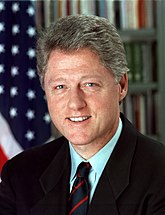
Summary
Positive
Clinton's presidency is marked by significant economic growth, the creation of 22.5 million jobs, and the lowest poverty rates in decades. His administration is credited with fiscal discipline that reversed a $290 billion deficit into a $124 billion surplus, and he successfully implemented major reforms such as the Family and Medical Leave Act and the North American Free Trade Agreement.
Negative
Clinton's presidency faced criticism for moral failures, particularly the administration's inaction during the Rwandan genocide and the controversial 1994 Crime Bill, which contributed to mass incarceration. His healthcare reform efforts were a significant political defeat, and his personal scandals, including impeachment, overshadowed his legislative achievements.
Basic Information
| Full Name | Bill Clinton |
|---|---|
| Party | Democratic |
| Term | Jan 20, 1993 - Jan 20, 2001 |
| Lifespan | Born 1946 |
| Vice President(s) | Al Gore |
| Prior Office | 40 & 42 Governor of Arkansas ((1979–1981 & 1983–1992)) |
Education
| Degree | Juris Doctor (J.D.) |
|---|---|
| Studies | Foreign Service, Politics, Law |
Election Results
| Election Year(s) | 1992 |
|---|---|
| Primary Opponent(s) | George H.W. Bush |
| Popular Vote | 44909889 (43.0) |
| Electoral Votes | 370 / 538 |
| Voter Turnout | 58.1 |
Bill Clinton: The Complex Legacy of America’s 42nd President
Bill Clinton: The Complex Legacy of America’s 42nd President
Bill Clinton, the 42nd President of the United States, served from 1993 to 2001, during a time of remarkable changes in American politics and society. Known for his charismatic personality and policy innovations, Clinton’s presidency remains a topic of fascination due to its contrasts: economic prosperity alongside personal and political scandals. This article will explore his early life and rise to power, significant accomplishments, controversies, and his lasting influence on American politics.
Early Life and Rise to Power
Born on August 19, 1946, in Hope, Arkansas, William Jefferson Clinton grew up in a working-class family. His early life was shaped by a desire to help his community and make a difference in politics. After graduating from Georgetown University in 1968, Clinton received a Rhodes Scholarship to the University of Oxford, followed by earning his law degree at Yale Law School, where he met his future wife, Hillary Rodham.
Clinton's political career began in Arkansas, where he was elected Attorney General in 1976. He became the youngest governor in U.S. history in 1979 at the age of 32, leveraging his charisma and political acumen, although he faced failure in his first re-election campaign in 1980. After a two-year hiatus in private practice, he returned to the governorship in 1983 and served until he won the presidency in 1992, defeating incumbent George H. W. Bush amid deep economic concerns.
Major Accomplishments
Economic Policies and Growth
Clinton's presidency is often remembered for its economic successes, which included a balanced budget and budget surpluses. He enacted the Omnibus Budget Reconciliation Act of 1993, raising taxes on the wealthy to combat a growing federal deficit. This bill passed without any Republican support but is credited with laying the groundwork for a lengthy economic expansion, creating millions of jobs.
Clinton championed the North American Free Trade Agreement (NAFTA), which removed trade barriers between the U.S., Canada, and Mexico. While controversial, it symbolized a shift toward a more globalized economy. He also implemented the Family and Medical Leave Act in 1993, which allowed workers to take unpaid leave for family emergencies, marking a significant step in U.S. labor rights.
Foreign Policy Achievements
Clinton's foreign policy saw both triumphs and challenges. One significant achievement was the Dayton Accords in 1995, which helped end the Bosnian War by fostering peace negotiations in Ohio. His administration also intervened in Haiti to restore democracy and acted decisively during the Kosovo War, leading a NATO bombing campaign against Serbian forces, which proved effective in stopping ethnic cleansing.
Controversies and Scandals
Despite these accomplishments, Clinton’s presidency was marred by significant controversies. The Whitewater investigation, which began as a probe into a real-estate investment, escalated into broader investigations into his and his wife’s conduct. This atmosphere of scrutiny laid the groundwork for a series of political crises.
One of the most infamous was the Monica Lewinsky scandal, wherein Clinton faced allegations of an inappropriate relationship with the White House intern. His denial during a deposition led to impeachment in 1998 for perjury and obstruction of justice—making him the second president in U.S. history to be impeached. However, the Senate acquitted him in early 1999, and Clinton remained quite popular with the American public.
The Human Side of Policy
Clinton's presidency is often idealized or criticized through the lens of his public and personal decisions. His ability to connect with voters and address their economic anxieties contributed significantly to his success but also created disillusionment when personal scandals emerged. He often employed the strategy of triangulation—positioning himself between the ideological extremes of both parties—which helped him appeal to a wider range of voters but alienated some within his party.
Legacy and Impact
Bill Clinton left office in January 2001, with high approval ratings and a booming economy. However, his presidency's complexities present a mixed legacy. He is remembered for significant economic reforms and peace keep initiatives, but also for his administration’s failures regarding humanitarian crises, such as the Rwandan Genocide, and the unintended consequences of mass incarceration policies stemming from the 1994 Crime Bill.
Ultimately, Clinton’s presidency highlighted the contradictions within modern American politics. His ability to manage economic growth during a time of global change contrasts sharply with the personal failures that beset him. His evolution of the Democratic Party towards more centrist views has had a lasting effect, even as the party faces ongoing challenges in aligning progressive ideals with broader electoral success.
Conclusion
The story of Bill Clinton’s presidency is a complex narrative of triumphs and tribulations. While he governed during a time of significant economic success, his presidency was not without challenges that continue to resonate in American politics today. His legacy is a reminder of the intricacies of leadership in an evolving political landscape, marked by both achievements and failures that have become key parts of the national discourse.