George Herbert Walker Bush
President #41 • Republican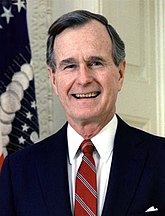
Summary
Positive
George H. W. Bush's presidency is marked by significant foreign policy achievements, including the successful management of the end of the Cold War, the liberation of Kuwait during the Gulf War, and the signing of important arms control treaties. Domestically, he championed landmark legislation such as the Americans with Disabilities Act and the Clean Air Act Amendments, showcasing a commitment to civil rights and environmental protection.
Negative
Bush's presidency faced criticism for economic mismanagement, particularly due to a recession and the violation of his 'no new taxes' pledge, which alienated conservative supporters. His administration also struggled with domestic issues, including the AIDS crisis and the perception of being out of touch with the electorate, culminating in a failed reelection bid in 1992.
Basic Information
| Full Name | George Herbert Walker Bush |
|---|---|
| Party | Republican |
| Term | Jan 20, 1989 - Jan 20, 1993 |
| Lifespan | 1924–2018 |
| Vice President(s) | Dan Quayle |
| Prior Office | 43 Vice President of the United States |
Education
| Degree | Bachelor's degree in economics |
|---|---|
| Studies | economics |
Election Results
| Election Year(s) | 1988 |
|---|---|
| Primary Opponent(s) | Michael Dukakis |
| Popular Vote | 48886597 (53.4) |
| Electoral Votes | 426 / 537 |
George H.W. Bush: The Last Patrician and His Complex Legacy
Introduction: The Custodian of Transition
The presidency of George Herbert Walker Bush (1989–1993) marks a turning point in American political history, bridging the certainties of the Cold War with the complexities of a modern world. Serving as the forty-first President of the United States, Bush brought extensive experience to the Oval Office as a decorated naval aviator, oil executive, Congressman, and Vice President. His presidency highlighted a striking paradox: a successful global strategist who played a crucial role in ending the Cold War but ultimately struggled to communicate his vision domestically amid economic challenges.
A Life Shaped by Duty
Born on June 12, 1924, in Milton, Massachusetts, George H.W. Bush was raised in an elite family that emphasized duty and public service. His father, Prescott Bush, was a U.S. Senator who taught him the values of modesty and hard work. By the age of 18, Bush enlisted in the Navy as World War II unfolded and became the youngest pilot in the Navy. His military service would greatly influence his leadership style. After surviving a harrowing attack that saw his plane shot down, he developed a deep sense of responsibility, a trait he carried into his political career.
Bush’s educational journey took him to Yale University, where he excelled academically and participated in extracurricular activities, including baseball and fraternity life. Choosing entrepreneurial paths over typical East Coast financial careers, he moved to Texas and began building his identity in the oil industry—a blend of his high-society upbringing and rugged Texan persona that would later appeal to a wide voter base.
Forging a Path to the Presidency
Bush’s political career began in earnest when he was elected to the U.S. House of Representatives in 1966. Over the next two decades, he served in various capacities, including Chairman of the Republican National Committee and Director of the CIA, which equipped him with a deep understanding of government and foreign affairs. This extensive experience helped pave the way for his successful bid for the presidency in 1988.
Despite initial doubts about his toughness and calls of the “wimp factor,” Bush's campaign strategy would soon turn the tables. He won the presidency against Massachusetts Governor Michael Dukakis by highlighting the benefits of peace and stability during a time of economic uncertainty.
Navigating Domestic Policy
While often overshadowed by his foreign policy achievements, Bush’s domestic agenda is noteworthy. His approach was characterized by “compassionate conservatism,” aimed at preserving and enhancing social programs while advocating for conservative values. This approach garnered bipartisan support but eventually alienated some conservatives who sought a more radical agenda.
**Key Achievements:
-
The Americans with Disabilities Act (ADA):** This landmark legislation, signed in 1990, prohibited discrimination against individuals with disabilities in various domains, significantly improving accessibility in public spaces.
-
The Clean Air Act Amendments of 1990:** In contrast to the Reagan years, Bush took substantial steps towards environmental regulation by implementing a market-based framework to combat acid rain.
Bush faced significant challenges during his presidency, particularly relating to economic issues. The U.S. economy slipped into recession, exacerbated by rising unemployment and inflation. His decision to raise taxes—a betrayal of his famous campaign pledge of “Read my lips: no new taxes”—caused backlash and diminished support from his conservative base.
Foreign Policy: Mastering a New World Order
Bush’s foreign policy legacy remains one of his most significant successes. His administration played a pivotal role in the peaceful conclusion of the Cold War, opting for diplomacy over confrontation and supporting the reunification of Germany. His response to the Gulf War in 1990 demonstrated an effective coalition-building approach that would set a model for international relations.
Bush effectively assembled a wide-ranging coalition to liberate Kuwait after Iraq's invasion, emphasizing diplomacy that avoided the pitfalls of overwhelming force—a strategy that historians regard as a hallmark of his presidency.
Controversies and Challenges
However, his presidency was not lacking in controversy. The pardons related to the Iran-Contra scandal at the end of his term raised ethical questions, as did accusations of negligence regarding the AIDS crisis. Additionally, Bush struggled with internal critiques during his term. The Los Angeles riots in 1992 tested his leadership capabilities, revealing challenges in addressing urban poverty and racial tensions.
The Road to Defeat
By 1992, Bush faced a challenging reelection climate. With an economy struggling to recover and a formidable challenge from Bill Clinton and independent Ross Perot, he lost support among both moderates and conservatives dissatisfied with his policies. His final election campaign symbolized the struggle to maintain a coalition amidst rising ideological purism within his party, culminating in his defeat and the end of a twelve-year Republican hold on the White House.
Reflections on Legacy
Since his departure from office, perceptions of George H.W. Bush have shifted. Today, historians tend to see him as a competent leader skilled in foreign affairs but lacking a robust domestic vision. His presidency exemplified a transition from moderate conservatism to a more ideologically divided Republican Party—setting the stage for the confrontations to come.
Bush’s legacy continues to provoke discussion regarding the balance between global diplomacy and domestic policies. As the last president from the so-called “patrician” class, his administration offered valuable lessons on governance, and the consequences of leadership decisions that blend pragmatism with ideology.
In a changing political landscape, Bush's presidency remains a touchstone for discussions about the direction of the Republican Party and the complexities of American governance. His story serves as a reminder that competent governance requires a balance of vision and adaptability, traits that are often hard to maintain amid competing interests and public pressures.