Ronald Reagan
President #40 • Republican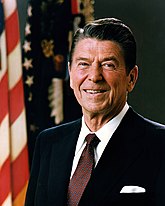
Summary
Positive
Reagan's presidency is marked by significant accomplishments including the end of the Cold War, a robust economic expansion, and a revitalization of national confidence. His policies, known as Reaganomics, successfully reduced inflation and spurred job growth, while his diplomatic efforts with Mikhail Gorbachev led to landmark treaties that reduced nuclear arsenals.
Negative
Despite his successes, Reagan's presidency faced criticism for increasing national debt, failing to balance the budget, and a slow response to the AIDS epidemic. His administration was also marred by scandals such as the Iran-Contra Affair, which raised serious constitutional questions about executive power.
Basic Information
| Full Name | Ronald Reagan |
|---|---|
| Party | Republican |
| Term | Jan 20, 1981 - Jan 20, 1989 |
| Lifespan | 1911–2004 |
| Vice President(s) | George H. W. Bush |
| Prior Office | 33 Governor of California ((1967–1975) ) |
Education
| Degree | Bachelor of Arts (B.A.) |
|---|---|
| Studies | Economics and Sociology |
Election Results
| Election Year(s) | 1984 |
|---|---|
| Primary Opponent(s) | Walter Mondale |
| Popular Vote | 54358205 (58.8%) |
| Electoral Votes | 525 / 538 |
| Voter Turnout | 55.2% |
The Legacy of Ronald Reagan: America’s Cheerful Warrior
The Legacy of Ronald Reagan: America’s Cheerful Warrior
Ronald Reagan, the 40th President of the United States, served from 1981 to 1989. He was an icon of American conservatism and played a pivotal role in shaping modern politics. His presidency, often referred to as the Reagan Revolution, was marked by significant victories and equally notable controversies that continue to spark debates today.
The Man Behind the Curtain
Born on February 6, 1911, in a modest Illinois town, Reagan grew up in a family that valued faith and hard work. His father was a shoe salesman, and his mother often encouraged his love for drama and public speaking. This early background fostered a style of optimism that would define his political career. Reagan's path to the presidency was unconventional. Originally an actor in Hollywood, he transitioned to politics in the 1960s when he became a vocal supporter of conservative causes.
His television prowess shone through when he delivered his famous speech supporting Barry Goldwater during the 1964 election, positioning him as a dynamic voice for the Republican Party. If there was a turning point in his political saga, it was that moment, where he became known as the “Great Communicator.”
An Electoral Tsunami
Reagan’s presidential candidacy came at a time of national discontent. The 1980 election followed years of economic turmoil under President Jimmy Carter, characterized by high inflation, energy crises, and the Iranian Hostage Crisis. Reagan’s simple yet effective campaign slogan, "Are you better off than you were four years ago?" resonated with voters eager for change.
When the dust settled on Election Day, Reagan emerged victorious, winning over 50% of the popular vote and a whopping 489 electoral votes, marking a significant shift toward conservatism in American politics.
He clinched reelection in 1984, rallying support with an optimistic message of economic recovery dubbed “Morning in America.” Polls reflected the public's approval, with Reagan winning 49 states, a testament to the overwhelming support he garnered.
Policies that Shaped a Generation
Reagan's domestic and foreign policies had profound impacts. His economic agenda, known as “Reaganomics,” focused on reducing government intervention, cutting taxes, and rolling back regulations. His administration achieved the Economic Recovery Tax Act of 1981, slashing tax rates, which proponents argued spurred economic growth. However, this doctrine also contributed to a tripling of the national debt by his presidency's end—a fact that critics often highlight.
On the foreign front, Reagan's policy was marked by a robust military buildup. He championed a tough stance against communism—most famously through the Strategic Defense Initiative, aiming to protect the U.S. from nuclear missiles. Perhaps his most heated stance was the active rollback of Soviet influence in regions like Central America, where he supported Contra rebels in Nicaragua—actions that led to the Iran-Contra scandal, tainting his legacy. Ronald Reagan is often referred to as the president who brought the Cold War to an end, through a blend of pressure and diplomacy, particularly in dealings with Soviet leader Mikhail Gorbachev.
Accomplishments and Failures
Reagan’s legacy remains mixed. On one side, he is credited with revitalizing the economy after the stagflation of the 1970s, fostering a period of strong growth and job creation. On the flip side, his policies also led to increased income inequality and massive national debt.
Promoting laws such as the Tax Reform Act of 1986, which simplified the tax code and provided lower taxes for millions, is hailed as a bi-partisan achievement. Yet, his administration faced criticism for neglecting social issues, failing to adequately address the AIDS crisis until it was too late, and cutting programs meant to aid America’s most vulnerable citizens.
The Man of Controversies
Reagan's presidency wasn’t without scandal. The Iran-Contra Affair stands out—a situation where senior officials secretly facilitated arms sales to Iran, despite an embargo, funneling proceeds to support Contra rebels in Nicaragua, violating Congress's Boland Amendment. This led to a significant loss of public trust when the truth emerged.
His friendship with political rivals, especially Speaker of the House Tip O'Neill, showcased the complexities of navigating bipartisan relationships in a highly polarized environment. Despite their differences, the two men maintained a personal rapport, demonstrating that even in politics, camaraderie is possible.
Conclusion: The Enduring Reagan Legacy
Evaluating Ronald Reagan's presidency means grappling with both his achievements and shortcomings. He was a master communicator, who, through his two terms, helped reshape American political ideology toward conservatism and framed the national conversation around government’s role in society.
While his fiscal policies sparked economic growth, they also raised crucial questions about equality and responsibility. His standing on the world stage contributed to the end of the Cold War, establishing him as a significant figure in U.S. foreign policy history. As we navigate the political landscape of today’s America, the echoes of Reagan’s presidency persist, reminding us of both the promises and pitfalls of leadership.