James Madison
President #4 • Democratic-Republican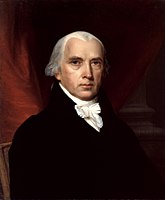
Summary
Positive
James Madison's presidency is marked by significant achievements such as the successful navigation of the War of 1812, the establishment of the Second Bank of the United States, and the implementation of the Tariff of 1816, which protected American industries. His intellectual contributions as the 'Father of the Constitution' and the primary drafter of the Bill of Rights solidified his legacy as a foundational figure in American democracy.
Negative
Madison's presidency faced challenges including the unpopularity of the Embargo Act, military incompetence during the War of 1812, and the burning of Washington, D.C. His reliance on state militias and ineffective cabinet appointments led to significant military failures, undermining his credibility and effectiveness as Commander in Chief.
Basic Information
| Full Name | James Madison |
|---|---|
| Party | Democratic-Republican |
| Term | Mar 4, 1809 - Mar 4, 1817 |
| Lifespan | 1751–1836 |
| Vice President(s) | George Clinton, Elbridge Gerry |
| Prior Office | 5 United States Secretary of State ((1801–1809)) |
Education
| Degree | Bachelor's degree in Hebrew and theology |
|---|---|
| Studies | Political philosophy, Hebrew, theology |
Election Results
| Election Year(s) | 1812 |
|---|---|
| Primary Opponent(s) | DeWitt Clinton |
| Popular Vote | 140431 (50.4%) |
| Electoral Votes | 128 / 217 |
Understanding James Madison: The Architect of the Constitution and His Complex Presidency
Understanding James Madison: The Architect of the Constitution and His Complex Presidency
James Madison, the fourth President of the United States, is often lauded as the 'Father of the Constitution' and the principal architect of many essential elements of American government. However, his presidency (1809-1817) showcases a dichotomy between his intellectual accomplishments as a founding father and the practical challenges he faced as a leader during a turbulent period in American history.
The Early Years: Education and Political Awakening
Born on March 16, 1751, in Virginia, Madison hailed from an influential family that had a significant impact on his early views and political aspirations. Unlike many of his contemporaries who attended local colleges or traveled abroad, Madison chose to study at the College of New Jersey (now Princeton University). His education there, especially his postgraduate studies in Hebrew and theology under President John Witherspoon, contributed significantly to his belief in the importance of structure and checks in government, a principle that would later shape his role in the drafting of the Constitution.
Madison's political career ignited swiftly; at just 25, he participated in drafting the Virginia Declaration of Rights in 1776, promoting the idea of religious freedom—a critical step toward the eventual establishment of church-state separation in America.
Architect of the Constitution
Madison’s profound impact was most notably felt during the Constitutional Convention in 1787. He played a crucial role in shaping the Constitution and introduced the Virginia Plan, advocating for a strong national government with a bicameral legislature. His meticulous notes of the debates provide a critical historical record of these formative discussions.
In the years that followed, Madison co-authored The Federalist Papers, a series of essays that defended the Constitution and offered insights into its meaning and purpose. These writings helped garner support for the ratification of the Constitution, underscoring Madison's crucial role in establishing the framework of the United States.
Later, as a member of the First Congress, he fulfilled a promise to his constituents by drafting the Bill of Rights, addressing concerns that the new Constitution didn’t sufficiently protect individual freedoms.
The Presidency: Challenges and Controversies
Upon entering the White House, Madison faced immediate challenges, including the growing tensions with Britain and rising nationalism amongst his party, the Democratic-Republicans. His first term was marked by frustration and a weak legislature, as he struggled to maintain authority over an increasingly divided nation, culminating in the War of 1812.
Ironically, the man who had designed a system of checks and balances found himself with limited power to guide the country through its first declared war. His reliance on the principles of his intellectual framework contrasted starkly with the failure of his initial strategies during the war, where the U.S. faced significant military setbacks, including the burning of Washington, D.C., in 1814.
Despite these challenges, Madison’s leadership during the war inspired a sense of national unity and resilience. His ability to navigate the United States through such a tumultuous time ultimately contributed to a stronger national identity.
A Shift Toward Economic Nationalism
Following the war, Madison's approach shifted significantly. The challenges faced during the conflict, particularly the economic hardships and the need for federal intervention, led him to embrace policies that many of his party members had previously opposed.
Madison supported the establishment of the Second Bank of the United States and endorsed protective tariffs to bolster American industry. This pivot towards economic nationalism somewhat contradicted his earlier strict constructionist views, signaling a maturation in his understanding of governance and economic policy.
A Mixed Legacy
Madison's presidency is often remembered for its complexity. While he laid foundational structures for the nation, he struggled with issues of military competence and dealing with the bureaucratic inefficiencies that plagued his administration. His failure to effectively lead troops or implement coherent military strategies during the War of 1812 diminished his reputation.
Additionally, Madison's legacy is marred by his ownership of slaves and his failure to take decisive action against the institution of slavery, even as he expressed moral objections to it. Unlike George Washington and Thomas Jefferson, who freed some of their slaves, Madison left his enslaved workers to his wife, leading future scholars to grapple with the moral implications of his life and leadership.
Conclusion: The Enduring Impact of Madison's Presidency
Madison’s presidency serves as an important chapter in the story of American democracy, illustrating the tension between ideals and practical governance. His intellectual contributions to the Constitution established enduring principles of American governance, while his experiences as president highlighted the complexities of leading a nation at war. As American society continues to evolve, Madison's influence persists, reminding us that the struggle for a more perfect union is both a historic and ongoing endeavor.
In retrospect, James Madison's journey from the architect of democracy to the challenges of presidential leadership reflects a profound narrative of growth, contradiction, and resilience, ultimately shaping the United States as we know it today.