Jimmy Carter
President #39 • Democratic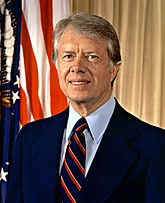
Summary
Positive
Carter's presidency was marked by significant achievements in domestic policy, including economic deregulation, the establishment of the Department of Energy, and a commitment to environmental protection. His foreign policy successes included the Camp David Accords, which facilitated peace between Israel and Egypt, and the negotiation of the Panama Canal Treaties, which improved relations with Latin America. He also made substantial strides in social reform, expanding the Food Stamp program and increasing the minimum wage.
Negative
Carter's presidency faced severe challenges, including the Iran Hostage Crisis, which became a defining moment of his administration and contributed to his electoral defeat in 1980. His 'Malaise' speech was perceived as a failure, as it was interpreted by the public as blaming them for the nation's problems. Additionally, his administration was marred by scandals such as the Bert Lance Affair and controversies involving his brother Billy Carter.
Basic Information
| Full Name | Jimmy Carter |
|---|---|
| Party | Democratic |
| Term | Jan 20, 1977 - Jan 20, 1981 |
| Lifespan | Born 1924 |
| Vice President(s) | Walter Mondale |
| Prior Office | 76 Governor of Georgia ((1971–1975)) |
Education
| Degree | Bachelor of Science |
|---|---|
| Studies | Nuclear Physics |
Election Results
| Election Year(s) | 1976 |
|---|---|
| Primary Opponent(s) | Gerald Ford |
| Popular Vote | 40831881 (50.1) |
| Electoral Votes | 297 / 537 |
| Voter Turnout | 54.8 |
Understanding Jimmy Carter: The Presidency of a Trustworthy Leader
Understanding Jimmy Carter: The Presidency of a Trustworthy Leader
Jimmy Carter, the 39th President of the United States, served from 1977 to 1981. His presidency marked a pivotal period in American history, transitioning from post-World War II liberalism to the dawn of modern conservatism. While many recall his presidency primarily for its struggles, such as stagflation and the Iran hostage crisis, Carter's time in office was also characterized by meaningful reforms and forward-thinking policies.
Early Life and Background
Born on October 1, 1924, in Plains, Georgia, Jimmy (James Earl Carter Jr.) was shaped by his early life experiences. Growing up in a modest farming community during the Great Depression, he witnessed firsthand the harsh realities of poverty and racial segregation. His father, James Earl Carter Sr., was a successful farmer and community figure, while his mother, Lillian, a nurse, instilled in him values of compassion and justice. This background laid the foundation for Carter’s commitment to civil rights and his approach to governance as a trustee—someone who prioritizes the common good over political gain.
Path to the Presidency
Carter’s academic achievements were noteworthy for a man of his time. He graduated from the U.S. Naval Academy in 1946, embarking on a distinguished military career in the Navy's submarine service. His military discipline and technical background influenced his methodical approach to problem-solving and governance.
After his father’s death, Carter returned to Georgia to manage the family’s peanut farm. His political career began on a local level, where he served on the county board of education and later became a state senator. As Governor of Georgia from 1971 to 1975, Carter gained national attention for his progressive stances, including a bold declaration against racial discrimination.
The 1976 Presidential Campaign
In 1976, amid a nation fatigued by the Vietnam War and the Watergate scandal, Carter emerged as a political outsider. He campaigned with promises of integrity and transparency. His slogan, “A Leader for a Change,” resonated with an electorate yearning for a restoration of faith in leadership. Despite starting as an underdog, he secured a narrow victory against then-incumbent President Gerald Ford, winning the presidency with a coalition that appealed to a broad spectrum of American voters.
Major Accomplishments
Carter’s presidency, although marred by challenges, also produced significant achievements:
-
Economic Deregulation: Carter dismantled federal controls over the airline industry with the Airline Deregulation Act of 1978, which resulted in affordable air travel for the middle class. He extended this deregulation to trucking and railroads, encouraging competition and reducing costs for consumers.
-
Energy Policy: In response to the 1970s energy crisis, Carter emphasized energy conservation and alternative energy sources. His administration established the Department of Energy and promoted solar and wind power, framing the energy crisis as “the moral equivalent of war.”
-
Environmental Protection: Under his administration, the National Park System was significantly expanded, and the Alaska National Interest Lands Conservation Act was signed to protect over 100 million acres of wilderness.
-
Human Rights Advocacy: Carter made human rights a cornerstone of foreign policy, insisting on moral considerations in diplomatic relations. This was evident in his administration’s support for human rights in countries such as Chile and El Salvador.
-
Camp David Accords: One of Carter's most notable foreign policy successes was brokering peace between Israel and Egypt in 1978, culminating in the Camp David Accords. This historic agreement secured Egypt’s recognition of Israel and effectively reshaped Middle Eastern politics.
Struggles and Criticisms
Despite these achievements, Carter's presidency was plagued by significant challenges:
- Stagflation: The combination of high inflation and unemployment overshadowed economic achievements, leading to a crisis of confidence in his administration.
- Iran Hostage Crisis: The seizure of the U.S. Embassy staff in Teheran and their subsequent captivity for 444 days hurt Carter's reputation and led to his defeat in the 1980 election.
- Political Missteps: Carter’s 1979 “Malaise Speech,” intended as a call for unity, was perceived by many as a blame directed towards the American public, further eroding his popularity.
Legacy and Impact
Jimmy Carter’s presidency remains a topic of debate, yet its impact is undeniably significant. He was ahead of his time in advocating for deregulation and human rights, setting the stage for future administrations. His appointment of diverse judges helped reshape the judiciary and is a lasting part of his legacy.
After leaving office, Carter continued to play a vital role as a humanitarian and peacemaker, mitigating damage to his reputation through decades of philanthropy and advocacy work.
In conclusion, the story of Jimmy Carter is one of a leader who navigated complex issues with integrity, often paying a political price for his vision. He reminds us that true leadership requires both wisdom and courage, especially in challenging times.
Key Takeaways
- Carter's presidency was marked by significant deregulation and a focus on human rights.
- Achievements include the Camp David Accords and substantial environmental protections.
- He faced severe challenges, including inflation and the Iran hostage crisis, impacting his popularity.
- Often viewed as a man committed to the public good, Carter left a complex but impactful legacy.