Gerald Ford
President #38 • Republican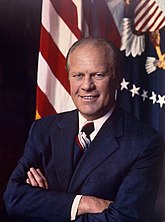
Summary
Positive
Ford stabilized the executive branch's legitimacy while inadvertently fueling the ideological realignment that would culminate in the Reagan Revolution. He stabilized the economy, extricated the U.S. from Vietnam, established the Strategic Petroleum Reserve, reformed the CIA, and codified rights for disabled children.
Negative
The Nixon pardon remains the defining controversy, arguably costing him the 1976 election but saving the country from years of litigation. The Mayaguez incident and the 'Eastern Europe' gaffe highlighted the difficulties of managing a superpower in decline.
Basic Information
| Full Name | Gerald Ford |
|---|---|
| Party | Republican |
| Term | Aug 9, 1974 - Jan 20, 1977 |
| Lifespan | 1913–2006 |
| Vice President(s) | Office vacant, August 9 – December 19, 1974, Nelson Rockefeller, December 19, 1974 – January 20, 1977August 9 – December 19, 1974, Nelson Rockefeller, December 19, 1974 – January 20, 1977 |
| Prior Office | 40 Vice President of the United States |
Education
| Degree | LL.B. |
|---|---|
| Studies | economics and political science |
Election Results
| Election Year(s) | 1976 |
|---|---|
| Primary Opponent(s) | Ronald Reagan |
| Popular Vote | 39148634 (48.0) |
| Electoral Votes | 240 / 537 |
Gerald Ford: The Unlikely President Who Stepped into a Storm
Gerald Ford: The Unlikely President Who Stepped into a Storm
A New Beginning Amid Crisis
Gerald R. Ford served as the 38th President of the United States from 1974 to 1977, making history as the only person to hold the presidency without being elected to either the position or the vice presidency. Ford took office during one of the most challenging times in American history—a nation reeling from the Watergate scandal and a divisive Vietnam War. With integrity and a steady hand, Ford aimed to restore faith in the presidency and navigate his country through turbulent waters.
The Early Years: A Life Shaped by Resilience
Born Leslie Lynch King Jr. on July 14, 1913, in Omaha, Nebraska, Ford's early life was marked by instability. His parents’ tumultuous relationship led his mother to escape with him to Grand Rapids, Michigan, where she remarried. This stability fostered in Ford a deep-seated respect for order and institutions. His childhood values of service and duty would later guide his leadership style.
Ford was an accomplished athlete; he played football at the University of Michigan and was named the team’s Most Valuable Player. After graduating from law school at Yale, he briefly considered a professional football career before deciding on public service and politics.
From Congress to the Presidency
Ford began his political career in the U.S. House of Representatives, where he served for 25 years before becoming vice president under Richard Nixon. His climb to the presidency was sudden and surprising. Following Nixon's resignation due to Watergate, Ford was sworn in as president on August 9, 1974. In his inaugural address, he famously declared, “My fellow Americans, our long national nightmare is over,” aiming to reassure a weary nation.
The Pardon Controversy: A Defining Act
Just a month into his presidency, Ford made a bold and controversial decision: he pardoned Nixon for all crimes committed while in office. Ford believed that a trial would only prolong the national turmoil and impede the country's healing process. The backlash was severe; his approval ratings plummeted, and many felt he had betrayed the public's trust. However, Ford maintained that his actions were in the best interest of the nation’s unity. This decision remains a pivotal point of debate regarding his legacy.
Navigating Economic Turbulence
While grappling with the fallout from the Nixon pardon, Ford faced significant economic challenges. The U.S. was in the grips of “stagflation”—a troubling mix of stagnant economic growth and high inflation. Ford’s initial response was criticized for its simplicity, famously launching the “Whip Inflation Now” (WIN) campaign, which encouraged Americans to save more and spend less. The campaign fell flat, drawing ridicule for its lack of substance.
Recognizing the need for a more robust economic strategy, Ford shifted his approach to include tax cuts aimed at stimulating demand. By late 1976, inflation had significantly decreased, although unemployment remained high. This period was a crucial test of Ford’s leadership as he worked to restore economic stability while trying to avoid further damage to the presidency’s reputation.
Foreign Policy: A Balancing Act
In foreign affairs, Ford inherited a significantly weakened global position due to the end of the Vietnam War and the complexities of Cold War politics. Notably, Ford managed the fall of Saigon and the subsequent evacuation of American personnel, a situation that underscored the difficulties of maintaining U.S. influence abroad after decades of war.
Another key event was the Mayaguez incident in 1975, where Ford ordered a military rescue mission after the Cambodian government seized an American merchant vessel. The operation resulted in the rescue of the ship's crew but came at a high cost, emphasizing the risk and volatility that characterized U.S. foreign policy during this period.
Additionally, the Helsinki Accords signed in 1975, while seen as controversial at the time due to their recognition of Soviet influence in Eastern Europe, are now viewed as a major step in promoting human rights, which would later play a crucial role in the eventual collapse of the Soviet Union.
The 1976 Election: A Tough Battle
As the 1976 election approached, Ford found himself facing a strong challenge from former Georgia Governor Jimmy Carter. His presidency was evaluated through the lens of the American public, which was divided over his record and the aura of scandal surrounding his previous administration.
In a tightly contested race, Ford lost to Carter, a result influenced by the economic issues and the controversies lingering from the pardon. Although he lost, the election was notably close, indicating that many Americans still supported the integrity and steadiness he represented.
Legacy: A President of Integrity
Gerald Ford’s presidency, though brief at just under three years, was transformative in restoring a sense of honor and normalcy to the American government after a harrowing period. His accomplishments included key economic policies, significant foreign relations achievements, and a lasting impact on civil rights through legislation such as the Education for All Handicapped Children Act.
Despite controversies, including the Nixon pardon and his struggles with a Democratic Congress, Ford is often seen as a stabilizing force. His presidency may not have offered radical transformation, but his modest and human approach to leadership helped bridge a divided nation toward recovery and laid the groundwork for future administrations.
In the end, Gerald Ford proved that “our Constitution works,” highlighting the importance of integrity and stability in leadership.
Key Takeaways
- Gerald Ford became president during an unprecedented crisis following Watergate and the Vietnam War.
- He pardoned Richard Nixon, a highly controversial act aimed at national healing.
- Ford struggled with economic issues, implementing both the WIN campaign and tax cuts to address stagflation.
- His foreign policy efforts included a response to the Vietnam War and the Helsinki Accords.
- Ford’s presidency is often viewed as a time of restoration, contributing to the healing of American political norms and trust.