Richard Nixon
President #37 • Republican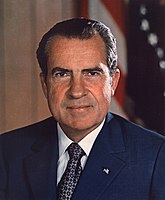
Summary
Positive
Nixon's presidency was marked by significant foreign policy achievements, including the opening of relations with China and the establishment of détente with the Soviet Union. Domestically, he expanded the federal regulatory state, creating the Environmental Protection Agency and implementing progressive policies on desegregation and Native American self-determination.
Negative
Nixon's presidency is overshadowed by the Watergate scandal, which led to his resignation and a profound erosion of public trust in government. His economic policies, particularly the wage and price controls known as the 'Nixon Shock,' contributed to long-term economic instability and inflation.
Basic Information
| Full Name | Richard Nixon |
|---|---|
| Party | Republican |
| Term | Jan 20, 1969 - Aug 9, 1974 |
| Lifespan | 1913–1994 |
| Vice President(s) | Spiro Agnew, January 20, 1969 – October 10, 1973, (Resigned from office), Office vacant, October 10 – December 6, 1973, Gerald Ford, December 6, 1973 – August 9, 1974, (Succeeded to presidency) |
| Prior Office | 36 Vice President of the United States ((1953–1961)) |
| Note | (Resigned from office) |
Education
| Degree | Unknown |
|---|---|
| Studies | History, Law |
Election Results
| Election Year(s) | 1972 |
|---|---|
| Primary Opponent(s) | George McGovern |
| Popular Vote | 478198694 (52.9%) |
| Electoral Votes | 520 / 538 |
Richard Nixon: The Contradictory Legacy of a Complex President
Richard Nixon: The Contradictory Legacy of a Complex President
Richard Nixon, the 37th President of the United States, was a man of contradictions. Born in a humble home in Yorba Linda, California, on January 9, 1913, Nixon rose from modest beginnings to become a significant figure on the world stage. His presidency spanned a turbulent time in American history, filled with remarkable achievements, troubling scandals, and a legacy that continues to spark debate today.
Early Life and Political Ascent
Nixon's upbringing shaped much of his character. Growing up in a lower-middle-class family, he faced challenges that fostered a fierce determination to succeed. His father operated a small grocery store, while his mother, a devoted Quaker, instilled in him a sense of morality that would often clash with his political ambitions.
Tragedy struck early in Nixon's life when two of his brothers died, leaving him with a profound sense of loss that likely influenced his later obsession with loyalty and achieving power. Despite these hardships, Nixon excelled academically, graduating summa cum laude from Whittier College and later from Duke University School of Law, where he further honed his legal skills.
His political career began during World War II when he served as a Navy lieutenant commander. Post-war, he entered politics, becoming a congressman in 1947. His early fame came from his role on the House Un-American Activities Committee, where he gained national attention for investigating alleged communist activities, most notably the case of Alger Hiss. Nixon's aggressive tactics painted him as a patriotic protector of American values, a theme that would permeate his political narrative.
The Vice Presidency and Presidential Campaigns
In 1952, Nixon was selected as Dwight D. Eisenhower's running mate, bringing a mix of experience and controversy to the ticket. During his tenure as vice president, he undertook important diplomatic missions, including a notable debate with Soviet Premier Nikita Khrushchev in 1959, showcasing his ability to engage with global leaders.
However, Nixon’s path was not without setbacks. He suffered a narrow loss to John F. Kennedy in the 1960 presidential race, but his defeat did not mark the end of his political journey. After a brief period away from the limelight and facing significant public ridicule, he re-entered politics, winning the California gubernatorial race in 1966, a stepping stone to his successful run for the presidency in 1968. His campaign was notable for leveraging the “Southern Strategy” to appeal to disaffected Southern whites post-Civil Rights Movement, a strategy that transformed American political dynamics.
Achievements in Office
Nixon's accomplishments in office were as significant as they were complex. He is perhaps best known for his groundbreaking foreign policy initiatives:
- The Opening to China: In February 1972, Nixon made a historic visit to Beijing, normalizing relations with China and forever altering the geopolitical landscape. This strategic move was celebrated as a masterstroke of diplomacy, effectively leveraging the Sino-Soviet split to the U.S.'s advantage.
- Détente with the Soviet Union: Nixon's negotiations led to the Strategic Arms Limitation Treaty (SALT I), helping to cool tensions during the Cold War. These efforts illustrated his ability to transcend partisan lines in pursuit of national interest.
Nixon’s domestic policy accomplishments were equally notable. He established the Environmental Protection Agency (EPA) and enacted the Clean Air Act, marking him as a significant advocate for environmental regulation. His administration made strides towards desegregating Southern schools more effectively than previous efforts.
The Watergate Scandal
Despite these achievements, Nixon’s presidency is indelibly marked by the Watergate scandal. What began as a seemingly minor break-in at the Democratic National Committee headquarters progressed into a vast web of political corruption. Investigations revealed a culture of cover-ups and illegal activities orchestrated by the Nixon administration to protect itself.
As the scandal unfolded, Nixon’s response included attempts to obstruct justice, ultimately leading to his resignation on August 9, 1974—the first U.S. president to resign in such a manner. The fallout from Watergate extended beyond Nixon, significantly eroding public trust in government and altering the relationship between the presidency and Congress.
Nixon's Mixed Legacy
Richard Nixon's legacy remains polarizing. On one hand, he was a pragmatic leader whose foreign policy accomplishments helped stabilize international relations and contributed to a new era of environmental awareness. On the other hand, the turmoil surrounding his presidency—marked by deceit, abuse of power, and scandal—has cast a long shadow.
As we reflect on Nixon's contributions, it is critical to remember both the man who brought China into the diplomatic fold and the president who established the blueprint for political scandal in America. His life stands as a testament to the complexities of power, ambition, and human fallibility.
Key Takeaways
- Richard Nixon’s presidency was characterized by significant achievements in foreign policy, including the opening of relations with China and détente with the Soviet Union.
- Domestically, he laid the groundwork for environmental regulation by establishing the EPA and implementing key legislative reforms.
- The Watergate scandal profoundly affected public trust in government and led to Nixon’s resignation, marking a significant moment in U.S. political history.
- Nixon’s legacy is a complex blend of monumental success and deep-seated controversy, making him one of the most studied figures in American history.
In conclusion, Richard Nixon's life story is a compelling exploration of a leader who, despite his ambitions and intellect, was ultimately undone by his own miscalculations and moral failings.