John Fitzgerald Kennedy
President #35 • Democratic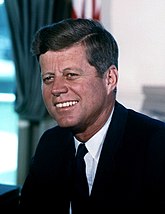
Summary
Positive
Kennedy's presidency is often remembered for its commitment to civil rights, the establishment of the Peace Corps, and significant advancements in space exploration, including the pledge to land a man on the Moon. His handling of the Cuban Missile Crisis is widely regarded as a masterclass in crisis management, showcasing his ability to navigate the most dangerous moments of the Cold War without escalating to nuclear conflict.
Negative
Kennedy's presidency faced criticism for the Bay of Pigs invasion, a disastrous CIA-backed operation that humiliated the U.S. and strengthened Fidel Castro's regime. Additionally, his administration's escalation of U.S. involvement in Vietnam and the controversial wiretapping of Martin Luther King Jr. marred his civil rights legacy and raised ethical concerns about his governance.
Basic Information
| Full Name | John Fitzgerald Kennedy |
|---|---|
| Party | Democratic |
| Term | Jan 20, 1961 - Nov 22, 1963 |
| Lifespan | 1917–1963 |
| Vice President(s) | Lyndon B. Johnson, (Succeeded to presidency) |
| Prior Office | U.S. Senator (Class 1) from Massachusetts ((1953–1960)) |
| Note | (Died in office) |
Education
| Degree | Bachelor of Arts |
|---|---|
| Studies | government |
Election Results
| Election Year(s) | 1960 |
|---|---|
| Primary Opponent(s) | Hubert Humphrey |
| Popular Vote | 34220984 (49.72) |
| Electoral Votes | 303 / 538 |
| Voter Turnout | 63.8 |
John F. Kennedy: The Complex Legacy of a Camelot President
John F. Kennedy: The Complex Legacy of a Camelot President
John Fitzgerald Kennedy, often celebrated as the youthful and charismatic leader of the U.S., occupies a unique, almost mythological position in American history. His presidency, which lasted from January 20, 1961, until his tragic assassination on November 22, 1963, is often romanticized as a time of hope and elegance, referred to as the "Camelot" era. But a deeper look reveals a leader navigating a turbulent political landscape, struggling with personal health issues, and facing enormous pressures both domestically and internationally.
The Rise of a Young Leader
Born into a prominent family on May 29, 1917, in Brookline, Massachusetts, Kennedy was shaped by elite education and the high expectations of his father, Joseph P. Kennedy Sr. Despite significant health issues, including a debilitating autoimmune disease, he cultivated an image of vitality. Kennedy’s early years, marked by ambition and privilege, provided him the platform to enter politics, first as a congressman and then as a senator.
During his time in office, Kennedy became known for his charm and oratory skills, qualities that would later help him win the presidency, but his record was largely overshadowed by vast personalities and political titans like Lyndon B. Johnson.
The 1960 Presidential Election: A Narrow Victory
The 1960 presidential election was a pivotal moment in American political history, as it brought forth the first televised debates in the U.S. Voters witnessed Kennedy, then just 43 years old, confront the seasoned Richard Nixon. His youthful demeanor and adept control during the debates won him significant public favor, despite concerns regarding his Catholic faith. Ultimately, Kennedy won the election by a mere 112,827 votes, a testament to how close the political climate had become.
The New Frontier: Ambition Meets Reality
Kennedy's domestic agenda, dubbed the "New Frontier," aimed at ambitious goals, including civil rights, space exploration, and economic growth. However, he quickly faced opposition from a conservative coalition in Congress that often thwarted his legislative intentions. Kennedy’s two years in office were characterized by a frustrating tug of war between his grand ambitions and stark political realities.
Economic Challenges
Kennedy inherited a troubled economy recovering from recession and was advised to adopt Keynesian principles, enabling increased federal spending to stimulate economic growth. The results were impressive, with annual GDP growth averaging 5.2% during his presidency. Nevertheless, pivotal moments such as the 1962 Steel Crisis tested his leadership.
A confrontation with the steel industry over prices showcased Kennedy's willingness to take on powerful corporate interests. His public denunciation of steeper prices resulted in a rollback, securing a rare victory for a president battling corporate monopolies.
The Space Race
The race against the Soviet Union during the Cold War intensified when Soviet cosmonaut Yuri Gagarin became the first man in space. In response, Kennedy famously pledged to land a man on the Moon by the end of the decade, emphasizing the importance of American ingenuity and determination. This commitment led to the revitalization of NASA and intensified efforts in space exploration, culminating in the moon landing just under a decade later.
The Cold War and Foreign Affairs
Kennedy's foreign policy is an area both of great success and notable failure. His administration faced the Cuban Missile Crisis in 1962, a moment considered a peak in presidential crisis management. The prospect of nuclear war was looming as JFK navigated tense negotiations with Soviet leader Nikita Khrushchev. Ultimately, Kennedy’s strategy of avoiding escalation and pursuing diplomacy averted a potentially catastrophic conflict.
However, he also faced significant missteps, most glaringly the Bay of Pigs invasion which aimed to topple Fidel Castro's regime in Cuba. The operation was a humiliating failure, drawing widespread criticism and weakening Kennedy’s position both at home and internationally.
The Civil Rights Movement
Kennedy’s civil rights legacy reflects a complicated evolution. Initially cautious, prioritizing political safety over moral imperatives, he eventually recognized the need for strong action amidst growing protests and societal change. His landmark civil rights address in 1963 marked a pivotal shift in his approach, affirming the necessity for a comprehensive civil rights bill, despite the potential political fallout.
Personal Struggles and Controversies
Behind the scenes, Kennedy grappled with serious health issues, relying on various medications to manage persistent pain and illness, a hidden struggle that contrasted sharply with his public image. He also faced personal controversies, particularly regarding his relationships with women and connections to organized crime, which have marred his legacy in the eyes of some historians.
A Mixed Legacy
Kennedy's presidency remains a subject of intense debate. Celebrated for his eloquence and ideological boldness, he is equally critiqued for failures and institutional compromises, especially those related to civil rights. His assassination in 1963 immortalized him in the public imagination; many see him as a symbol of promise unfulfilled—a leader whose potential was tragically cut short.
His presidency embodied a mixture of the idealistic and the pragmatic, one that set the stage for the liberal policies that emerged in the 1960s. In reflection, while Kennedy did not live to see many initiatives through, he laid the very groundwork that would shape America for decades to come.
Through both his triumphs and failures, John F. Kennedy's complex legacy is not simply one of myth and nostalgia but a narrative rich with lessons on leadership, responsibility, and the challenges of governance in a rapidly changing world.