Dwight David Eisenhower
President #34 • Republican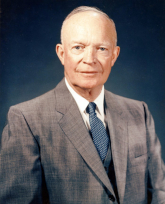
Summary
Positive
Eisenhower's presidency is marked by significant accomplishments such as the establishment of the Interstate Highway System, the expansion of Social Security, and the successful navigation of the Cold War, including the end of the Korean War. His leadership fostered economic prosperity and infrastructure development while maintaining a commitment to bipartisan governance.
Negative
Eisenhower's presidency faced criticism for its handling of civil rights, particularly his reluctance to take a strong public stance against segregation and his administration's involvement in the Lavender Scare, which led to the purging of thousands of federal employees based on sexual orientation. His strict fiscal policies also contributed to several recessions during his tenure.
Basic Information
| Full Name | Dwight David Eisenhower |
|---|---|
| Party | Republican |
| Term | Jan 20, 1953 - Jan 20, 1961 |
| Lifespan | 1890–1969 |
| Vice President(s) | Richard Nixon |
| Prior Office | Supreme Allied Commander Europe ((1949–1952)) |
Education
| Degree | Unknown |
|---|---|
| Studies | Military history, strategy, and philosophy |
Election Results
| Election Year(s) | 1956 |
|---|---|
| Primary Opponent(s) | Adlai Stevenson |
| Popular Vote | 35000000 (57.4) |
| Electoral Votes | 457 / 531 |
| Voter Turnout | 60.2 |
Dwight D. Eisenhower: The Hidden Hand of American Leadership
Introduction
Dwight D. Eisenhower served as the 34th President of the United States from 1953 to 1961, a time often viewed as tranquil and prosperous, yet fraught with social and political turbulence. Initially perceived as a relaxed caretaker, historical perspectives on Eisenhower's presidency have evolved significantly. Today, he is recognized for his subtle yet effective "Hidden Hand" approach, where his seemingly passive demeanor concealed a masterful strategy behind the scenes.
The Making of a Soldier-Statesman
Born on October 14, 1890, in Denison, Texas, and raised in Abilene, Kansas, Eisenhower's journey to the presidency was marked by his military career rather than political aspirations. Unlike many leaders of his time, his education came not from the halls of academia but from West Point, where he graduated middle-of-the-pack. His time in the military instilled a strong sense of duty, honor, and practical experience he would later leverage in his presidency.
Eisenhower’s rise during World War II showcased his exceptional ability to unify diverse military leaders under immense pressure. Handling personalities like General Patton and General Montgomery, his skills in diplomacy laid the groundwork for his leadership style, which mixed authority with a knack for consensus-building.
The Rise of a Political Leader
Eisenhower’s entry into politics came at a pivotal moment in American history—the 1952 presidential election. His campaign capitalized on American disillusionment with the Democratic Party, largely due to the ongoing Korean War and threats from Communism. His famous slogan "I Like Ike" resonated with Americans, leading to a commanding victory over Democrat Adlai Stevenson, solidifying his role as a key figure in reshaping the Republican Party.
In the 1956 election, Eisenhower successfully appealed to voters again, this time focusing on peace and prosperity as core themes. However, his success also revealed tensions in the Republican Party, as he struggled to maintain harmony between moderates and conservatives.
Achievements in Domestic Policy
Eisenhower defined his political philosophy as "Modern Republicanism," which aimed to blend traditional conservative principles with progressive social policies. He understood that dismantling the New Deal programs, a cornerstone of American welfare, was politically infeasible. Instead, he accepted and expanded programs like Social Security, significantly increasing coverage for millions of Americans.
One of his landmark achievements was the creation of the Interstate Highway System, an ambitious public works project that forever changed the American landscape, facilitating not just travel but also economic growth across the nation. This infrastructure project was positioned as vital for national defense, illustrating Eisenhower's ability to interweave domestic policy with Cold War concerns.
However, his presidency was not without economic challenges. Eisenhower's commitment to fiscal conservatism sometimes exacerbated economic downturns, leading to several recessions during his time in office. His approach favored balancing the budget over stimulating economic growth, which led to criticism from various quarters.
Civil Rights: A Reluctant Enforcer
Eisenhower’s legacy in civil rights is often seen as conflicting. While personally cautious about rapid change, he took monumental steps when necessary, notably federalizing National Guard troops to enforce desegregation in Little Rock, Arkansas, in 1957. This decisive action demonstrated his commitment to upholding federal authority but also highlighted his gradualist approach to implementing civil rights reforms.
His administration's initial reluctance culminated in the signing of the Civil Rights Act of 1957, the first significant piece of civil rights legislation since Reconstruction. This act aimed, albeit weakly, to address voting rights; however, the influence of Southern Democrats led to significant compromises that diminished its effectiveness.
Foreign Policy: The Balancing Act
Eisenhower's foreign policy was characterized by a strategy dubbed the "New Look," focusing on nuclear deterrence and covert operations rather than large military engagements. This shift allowed him to navigate the treacherous waters of the Cold War with an emphasis on strategic stability. His administration undertook significant covert operations, such as the overthrow of foreign leaders in Iran and Guatemala, which had lasting impacts on U.S. relations with those countries.
Additionally, Eisenhower successfully managed the end of the Korean War, a significant achievement that reflected his strategic diplomacy, as he hinted at military action to break the stalemate in negotiations over a ceasefire.
Controversies and Criticism
While Eisenhower is credited with many successes, his presidency was not free from scandal. The Sherman Adams affair, where his chief of staff resigned due to allegations of misconduct, undercut the administration's credibility. Additionally, Eisenhower's handling of McCarthyism, though ultimately effective in weakening Senator McCarthy's influence, has drawn scrutiny. Critics argue that his reluctance to publicly condemn McCarthy allowed damaging red-baiting politics to persist longer than necessary.
Legacy and Conclusion
Eisenhower's presidency left a profound mark on American history. He is often lauded for guiding the nation through a critical, turbulent decade, balancing various forces within both domestic and foreign arenas. His warning in his farewell address about the military-industrial complex remains relevant today, highlighting the delicate interplay between democracy and defense.
In retrospect, Eisenhower's time in office can be viewed as a crucial period of stabilization following World War II, where he managed to harmonize prosperity with emerging social change. His nuanced leadership style, often behind-the-scenes, belied a presidency that shaped the course of American history in significant ways, from infrastructure to civil rights, and left a complex, enduring legacy.