Franklin Delano Roosevelt
President #32 • Democratic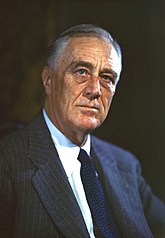
Summary
Positive
Roosevelt's presidency is marked by significant accomplishments including the establishment of the Social Security Act, which fundamentally altered the social contract between citizens and the state, and his leadership during World War II, which was crucial for the Allied victory. His New Deal policies helped stabilize the economy during the Great Depression and created a safety net for millions of Americans.
Negative
Roosevelt's presidency also faced criticism for significant failures such as the internment of Japanese Americans during World War II, which is viewed as a grave civil liberties violation. His attempt to pack the Supreme Court in 1937 was seen as an overreach of executive power and led to a backlash that weakened his legislative agenda.
Basic Information
| Full Name | Franklin Delano Roosevelt |
|---|---|
| Party | Democratic |
| Term | Mar 4, 1933 - Apr 12, 1945 |
| Lifespan | 1882–1945 |
| Vice President(s) | John N. Garner, March 4, 1933 – January 20, 1941, Henry A. Wallace, January 20, 1941 – January 20, 1945, Harry S. Truman, January 20 – April 12, 1945, (Succeeded to presidency) |
| Prior Office | 44 Governor of New York ((1929–1932) ) |
| Note | (Died in office) |
Education
| Degree | Bachelor of Arts (A.B.) |
|---|---|
| Studies | History |
Election Results
| Election Year(s) | 1936 |
|---|---|
| Primary Opponent(s) | Alf Landon |
| Popular Vote | 27750866 (60.8%) |
| Electoral Votes | 523 / 531 |
| Voter Turnout | 57.0% |
Franklin D. Roosevelt: The Architect of America’s Recovery and Transformation
Franklin D. Roosevelt: The Architect of America’s Recovery and Transformation
Franklin Delano Roosevelt (FDR) holds a unique place in American history, not just as a president but as a transformative figure who reshaped the nation during some of its most challenging times. He guided the U.S. through the Great Depression and World War II, leaving a legacy that still influences our social and political landscape today. In this article, we will explore his background, major achievements, controversies, and the lasting impact he had on America.
Early Life and Education
FDR was born on January 30, 1882, into a wealthy family in Hyde Park, New York. His privileged upbringing provided him with an excellent education and a network of influential connections. He attended Groton School, a prestigious preparatory school, where he was shaped by the ethos of public service. Later, he enrolled at Harvard University, where he was President of The Harvard Crimson and graduated with a degree in history.
Despite starting law studies at Columbia, he left to pursue a career in politics after passing the New York Bar exam. This decision marked the beginning of a political journey that would lead him to the highest office in the land. However, just as he seemed to reach his stride, tragedy struck: in 1921, he contracted polio, which left him paralyzed from the waist down. This challenge, however, enhanced his empathy and understanding of those in distress, further influencing his approach to leadership and reform.
Political Rise and the New Deal
FDR's ascent in politics began with his election to the New York State Senate in 1910. He quickly became known for his reformist stance, breaking from the corruption associated with Tammany Hall. His commitment to public service and effective governance earned him recognition, eventually leading to his appointment as Assistant Secretary of the Navy in 1913, a role he held through World War I.
After a brief period out of the public eye, FDR re-emerged as the Governor of New York in 1928, just as the Great Depression was beginning to engulf the nation. Confronted with soaring unemployment and widespread despair, Roosevelt implemented innovative relief programs at the state level. His approach to governance was marked by bold experimentation, laying the groundwork for his New Deal initiatives once he became president.
When FDR won the presidency in 1932, he promised a