Benjamin Harrison
President #23 • Republican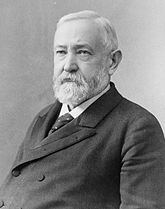
Summary
Positive
Harrison's presidency was marked by significant legislative achievements, including the Sherman Antitrust Act, the McKinley Tariff, and the Dependent and Disability Pension Act, which transformed the federal pension system for veterans. He also modernized the U.S. Navy and convened the first Pan-American Conference, establishing a framework for inter-American cooperation.
Negative
Harrison's administration faced criticism for the Wounded Knee Massacre, which marked a tragic end to the Indian Wars, and for fiscal irresponsibility during the 'Billion Dollar Congress,' which led to a depletion of the Treasury. His failure to pass the Lodge Bill to protect African American voting rights also marred his legacy.
Basic Information
| Full Name | Benjamin Harrison |
|---|---|
| Party | Republican |
| Term | Mar 4, 1889 - Mar 4, 1893 |
| Lifespan | 1833–1901 |
| Vice President(s) | Levi P. Morton |
| Prior Office | U.S. Senator (Class 1) from Indiana ((1881–1887)) |
Education
| Degree | Bachelor's degree |
|---|---|
| Studies | Law, History, Political Economy |
Election Results
| Election Year(s) | 1888 |
|---|---|
| Primary Opponent(s) | Grover Cleveland |
| Popular Vote | 5,443,892 (47.80) |
| Electoral Votes | 233 / 401 |
| Voter Turnout | 80.5 |
Benjamin Harrison: The Presidency of a Forgotten Reformer
Benjamin Harrison: The Presidency of a Forgotten Reformer
Benjamin Harrison served as the 23rd president of the United States from 1889 to 1893, yet his legacy often gets lost in the mix of larger-than-life figures in American history. Despite being part of a prominent political family—his grandfather was President William Henry Harrison—his journey to the White House was neither straightforward nor without bumps along the way.
Early Life and Career
Born on August 20, 1833, in North Bend, Ohio, Harrison grew up in a world that emphasized hard work and education. His family was rooted in a rich American tradition; his great-grandfather signed the Declaration of Independence. However, Harrison’s upbringing was relatively modest. He was educated in log cabin schools before attending Farmers’ College and then Miami University, where he honed his skills as a scholar and future leader.
A Young Lawyer
After graduating in 1852, Harrison chose a path in law, reading at a local lawyer's office before becoming a practicing attorney in Indianapolis. By the time he entered politics, Harrison had built a reputation for his keen legal mind and strong work ethic. Soon married to Caroline Scott, he quickly established himself in Indiana's political scene, rising through party ranks as a member of the recently formed Republican Party, which was gaining momentum in the post-Civil War era.
The Path to the Presidency
Harrison's political career began earning him public office when he was appointed as the City Attorney of Indianapolis in 1857. From there, he went on to serve in various capacities, including a term as a U.S. Senator from Indiana. Harrison’s tenure in the Senate helped solidify his reputation as a dedicated Republican capable of navigating complex political waters.
By 1888, he emerged as a candidate for the Republican nomination after several higher-profile candidates faltered. Harrison won the election against incumbent President Grover Cleveland, even though he lost the popular vote—making him one of the rare presidents to attain office without a majority.
Accomplishments and Contributions
Harrison’s term in office was marked by significant legislative accomplishments, earning the moniker “the Billion Dollar Congress.” Here are a few major initiatives:
-
Sherman Antitrust Act (1890): This landmark legislation aimed to curb monopolies and foster competition by declaring illegal every contract or conspiracy that restrained trade.
-
McKinley Tariff (1890): Under Harrison's leadership, this law raised tariff rates significantly, aimed at protecting American industries against foreign competition—especially vital during an era of rapid industrialization.
-
The Dependent and Disability Pension Act (1890): Harrison expanded veterans' benefits, fundamentally shifting the federal approach to veterans' welfare, which included both Union veterans and their families.
-
Forest Reserve Act (1891): In a forward-thinking move for conservation, Harrison set aside millions of acres for national forests, laying the foundations for America’s modern conservation movement.
-
Naval Expansion: Harrison played a crucial role in modernizing the U.S. Navy into a formidable force, pushing for the construction of new steamships that would be pivotal during future conflicts, including the Spanish-American War.
Controversies and Challenges
Despite these achievements, Harrison's presidency also faced significant controversies:
-
Wounded Knee Massacre: Perhaps the most glaring failure of his administration was the tragic Wounded Knee Massacre in 1890, which stemmed from a government crackdown on Native American spiritual movements. The event is often viewed as a severe stain on Harrison's record.
-
High Tariffs Backlash: The McKinley Tariff, while protective of American jobs, led to widespread discontent among consumers. In subsequent elections, Democrats blamed Harrison’s policies for making goods more expensive, contributing to Republican losses in the 1890 midterms.
-
The Bennett Law: This controversial law, which mandated English-only schooling, alienated significant German-American voters. Although a state issue, the backlash contributed to shifts in electoral support away from the Republicans.
The 1892 Election and Legacy
Harrison sought re-election in 1892, but he faced numerous headwinds, including internal party strife and economic troubles exacerbated by the high tariffs. Ultimately, he was defeated by Cleveland, making him the only president to lose to a predecessor.
While Harrison’s presidency might not stand out for its popularity, his accomplishments in terms of regulating monopolies, expanding the navy, and initiating conservation efforts stand as important pillars in the evolution of American governance. The foundation he laid in legislative powers had lasting effects, making him a pivotal figure who straddled the transition from the 19th to the 20th century.
Conclusion
In retrospect, Benjamin Harrison's presidency serves as a crucial chapter in American history. His efforts to reform various aspects of the federal government and provide for veterans reflected the complexities and challenges of his time. Despite facing criticism and controversies, Harrison's contributions helped shape the future trajectory of the United States, solidifying his place in history—not as a mere footnote—but as a reformer in his own right.