John Adams
President #2 • Federalist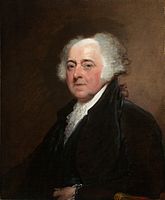
Summary
Positive
John Adams's presidency is marked by his refusal to engage in war with France during the Quasi-War, successfully negotiating peace and preserving the Union. His establishment of the Department of the Navy and the appointment of John Marshall as Chief Justice are also significant achievements that shaped the future of the American government.
Negative
Adams's presidency faced criticism for the enactment of the Alien and Sedition Acts, which were seen as violations of free speech and used to suppress opposition. His failure to veto these controversial laws and the internal conflicts within his cabinet further marred his reputation.
Basic Information
| Full Name | John Adams |
|---|---|
| Party | Federalist |
| Term | Mar 4, 1797 - Mar 4, 1801 |
| Lifespan | 1735–1826 |
| Vice President(s) | Thomas Jefferson |
| Prior Office | 1st Vice President of the United States |
Education
| Degree | A.B. |
|---|---|
| Studies | Mathematics, Natural Philosophy, Law |
Election Results
| Election Year(s) | 1796 |
|---|---|
| Primary Opponent(s) | Thomas Jefferson |
| Popular Vote | 35726 (51.4%) |
| Electoral Votes | 71 / 138 |
| Voter Turnout | 20.1% |
John Adams: The Founding Father Who Steered America Through Its Early Turbulence
The Life and Presidency of John Adams: A Revolutionary Leader in Uncertain Times
John Adams, the second president of the United States, is often remembered for his pivotal role in the founding of the nation. Born in 1735 in Massachusetts, Adams was a key figure in the American Revolution and the early years of the American republic. Despite being overshadowed by figures like George Washington and Thomas Jefferson, Adams's presidency (1797-1801) provides vital insights into the challenges of governance during the country’s formative years.
Early Life and Education: The Making of a Statesman
John Adams was born into a Puritan family and was steeped in the values of hard work and civic duty from an early age. His father, a farmer and Deacon, hoped that Adams would follow a clerical path, but young John felt drawn to law and public service. After attending local schools, he earned a place at Harvard College, where he was influenced not only by the prevailing religious teachings but also by Enlightenment rationalism. This combination of beliefs would shape his political philosophy for decades.
Upon graduating in 1755, he began teaching but soon transitioned to studying law under the mentorship of attorney James Putnam, thus laying the groundwork for a brilliant legal career. Adams’s reputation as an attorney eased his ascension into politics. He first served in local offices, notably opposing the British monarchy and advocating for colonial rights through his writings.
The Path to Power: From Lawyer to Revolutionist
Adams's political career began in earnest in the 1760s when he became a voice against British taxation without representation. He famously penned the Braintree Instructions, articulating that the colonists should not be taxed without having a say in the government. His writings under the pseudonym Humphrey Ploughjogger mixed humor with sharp legal arguments, effectively rallying public sentiment against British rule.
After gaining prominence, Adams served in the Continental Congress, where he firmly supported the push for independence. He was instrumental in nominating George Washington as commander-in-chief and was a member of the Committee of Five that drafted the Declaration of Independence. His contributions during this period made him a significant figure in the Revolution.
Presidential Election of 1796: The First Contested Vote
Adams’s presidency began amid political turmoil. The 1796 election marked the first true contest for the presidency, revealing deep divisions among the populace. Running as the Federalist candidate against fellow party member Thomas Pinckney and Democratic-Republican Thomas Jefferson, Adams secured a narrow victory, receiving 71 electoral votes against Jefferson’s 68. Despite his win, he struggled to unite a deeply divided nation.
A Tumultuous Presidency: Challenges at Home and Abroad
Adams's presidency was overshadowed by the Quasi-War with France, which erupted out of tensions following the French Revolution. The Hanburg Treaty and subsequent attacks on American shipping by the French strained relations. Adams's administration faced immense pressure to engage in war, yet he remained committed to avoiding conflict.
An important moment during this period was the XYZ Affair in 1798. Diplomats sent to negotiate peace with France were met with demands for bribes—this incident inflamed anti-French sentiment and strengthened the Federalists. However, rather than choosing war, Adams opted for diplomacy, stating, “I will not be the President who brings on a war.” This stance, while morally courageous, proved politically costly.
Domestic Controversies: The Alien and Sedition Acts
Internally, Adams faced backlash for the controversial Alien and Sedition Acts of 1798. These laws aimed to protect the nation from foreign influence and sedition but involved the suppression of speech and criticism against the government. The acts were widely viewed as an infringement on First Amendment rights and effectively alienated many supporters, paving the way for Adams's defeat in the 1800 election.
Legacy: Misunderstood and Maligned
Despite the controversies, Adams's presidency left an undeniable legacy. It was marked by his insistence on maintaining peace, his initiative in creating the Department of the Navy, and his appointment of John Marshall as Chief Justice, which significantly shaped the judiciary’s role in American government.
His most significant achievement may be his avoidance of war with France, which many historians believe preserved the fragile unity of the nation during a time of simmering tensions. Adams himself lamented the political fallout from his decisions but remained steadfast in his allegiance to the rule of law and national sovereignty.
John Adams left office unpopular and embittered, largely due to his inability to rally support around his policies effectively. In withdrawing from the political spotlight, he inadvertently set the stage for the peaceful transfer of power, a cornerstone of American democracy.
Conclusion: A Reassessment of John Adams
In contemporary evaluations, John Adams’s significant yet tumultuous presidency is receiving a new appreciation for its moral leadership. Seen now as a complex figure navigating the tumult of early American politics, Adams's commitment to peace against a backdrop of war hysteria showcases the nuanced challenges a leader must confront. As we reflect on his legacy, it becomes clear that Adams not only influenced the foundation of a nation but also established a model for enduring democratic governance.