Rutherford Birchard Hayes
President #19 • Republican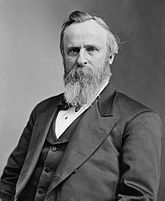
Summary
Positive
Hayes’s presidency is marked by significant accomplishments such as the restoration of the executive branch's authority, the establishment of civil service reform, and the successful resumption of specie payments, which stabilized the economy. His commitment to legal consistency and moral rectitude helped navigate the nation through a contentious political landscape.
Negative
Hayes's presidency is also characterized by failures, particularly the abandonment of civil rights for African Americans in the South following the withdrawal of federal troops. This decision allowed for the rise of oppressive 'Redeemer' governments and the nullification of the rights promised by the 14th and 15th Amendments.
Basic Information
| Full Name | Rutherford Birchard Hayes |
|---|---|
| Party | Republican |
| Term | Mar 4, 1877 - Mar 4, 1881 |
| Lifespan | 1822–1893 |
| Vice President(s) | William A. Wheeler |
| Prior Office | 29 & 32 Governor of Ohio ((1868–1872 & 1876–1877)) |
Education
| Degree | Bachelor of Laws (LL.B.) |
|---|---|
| Studies | Law |
Election Results
| Election Year(s) | 1876 |
|---|---|
| Primary Opponent(s) | Samuel J. Tilden |
| Popular Vote | 4033497 (47.9) |
| Electoral Votes | 185 / 369 |
| Voter Turnout | 81.8 |
Rutherford B. Hayes: The President Who Restored Integrity to a Troubled Nation
Introduction
Rutherford B. Hayes, the 19th President of the United States, served from 1877 to 1881 during a pivotal time in American history. As the nation was healing from the wounds of the Civil War and facing the challenges of the Gilded Age—the period of rapid economic growth and industrialization—Hayes emerged as a leader committed to restoring integrity to the presidency and fostering reconciliation in the deeply divided country. While he left office without the fanfare of more illustrious predecessors, Hayes’ legacy is important for understanding the evolution of the modern American state.
Early Life and Rise to Power
Born on October 4, 1822, in Delaware, Ohio, Hayes faced personal tragedy early on—the loss of his father before he was born. Raised by his mother and influential uncle, Hayes enjoyed an exemplary education, attending Kenyon College and then Harvard Law School, where he developed a respect for the law that would influence his political career.
Before becoming president, Hayes forged a significant path in political service, rising from local legal practice to political engagement during the Civil War, where he earned five wounds and the rank of Brevet Major General. Post-war, he served in the U.S. House of Representatives and later as the Governor of Ohio, gaining a reputation for fiscal responsibility and civil rights.
A Controversial Election
The 1876 election, considered one of the most controversial in U.S. history, fueled Hayes' ascent to the presidency. Hayes lost the popular vote to Democrat Samuel Tilden but won the presidency through an exceedingly narrow and contentious Electoral College victory. The election exposed the fragility of American democracy as it required the creation of a special Electoral Commission to adjudicate disputed votes. The resulting Compromise of 1877, which allowed Hayes to assume office in exchange for withdrawal of federal troops from the South, effectively marked the end of Reconstruction, leaving African American civil rights unprotected.
Achievements and Controversies
Restoration of Presidential Power
Despite facing a Congress openly hostile to his agenda, Hayes made significant strides to reinforce the power and legitimacy of the presidency. His assertive use of the veto allowed him to articulate a clear defense of executive authority, which had been compromised by previous administrations. This included his famous veto of an appropriation bill that attempted to strip the president of power, exemplifying his belief that the presidency was a co-equal branch of government, not merely a figurehead.
Civil Service Reform
Hayes championed the cause of civil service reform by issuing an executive order that prohibited federal employees from engaging in political activities, tackling the rampant patronage that plagued federal appointments. This move, while unpopular among some political factions, set the foundation for a more merit-based public service system, emphasizing integrity and professionalism.
Economic Management and the Resumption Act
In an era marked by economic depression, Hayes led the U.S. into its first economic recovery post-Civil War by resuming the convertibility of paper currency to gold, stabilizing the nation’s financial system. However, his opposition to the Bland-Allison Act, which aimed to increase the minting of silver, highlighted the tensions between fiscal restraint and populist pressures, drawing criticism from those in favor of inflationary policies.
Foreign Policy Perseverance
Hayes’ foreign policy efforts also deserve mention, particularly his arbitration award in the Paraguay-Argentina dispute, which showcased U.S. diplomatic authority and solidified Hayes' reputation as a global leader committed to peaceful resolutions. This would earn him respect abroad, contrasting sharply with domestic controversies.
Lasting Impact and Critiques
Hayes’ administration is often viewed through the lens of compromise. His withdrawal of troops from the South and the ensuing abandonment of African Americans' civil rights left a profound mark on the country, paving the way for decades of disenfranchisement and a lack of protection against racial violence. While some historians argue that his approach was pragmatic for fostering national unity, many believe it was a betrayal of the very principles he professed to uphold.
Despite this mixed legacy, Hayes is credited as a bridge to future reforms and for setting precedents in executive authority and civil service. His presidency represents the struggle between reconciliation and reform—an ongoing theme in American politics.
Conclusion
Rutherford B. Hayes navigated the treacherous waters of post-Civil War America with a commitment to integrity, albeit not without serious ethical costs. His presidency reasserted the dignity of the executive branch amid rampant political corruption while struggling to protect the rights of disenfranchised populations. Though often overshadowed by other historical figures, Hayes' contributions to restoring public faith in the presidency and providing a model for governmental integrity and reform resonate in today’s political discourse.