Ulysses S. Grant
President #18 • Republican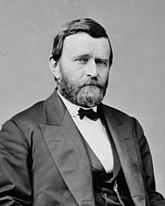
Summary
Positive
Grant's presidency is marked by significant achievements in civil rights, including the ratification of the 15th Amendment, the establishment of the Department of Justice, and the aggressive enforcement of federal laws to protect minority rights, particularly against the Ku Klux Klan. His foreign policy successes, such as the Treaty of Washington, also highlighted his commitment to international arbitration and peace.
Negative
Grant's administration faced severe criticism due to rampant corruption and scandals, including the Whiskey Ring and the Credit Mobilier scandal, which undermined public trust. His second term was marred by economic turmoil following the Panic of 1873, leading to a retreat from Reconstruction efforts and a failure to effectively address the systemic issues within his administration.
Basic Information
| Full Name | Ulysses S. Grant |
|---|---|
| Party | Republican |
| Term | Mar 4, 1869 - Mar 4, 1877 |
| Lifespan | 1822–1885 |
| Vice President(s) | Schuyler Colfax, (March 4, 1869 – March 4, 1873), Henry Wilson (March 4, 1873 – November 22, 1875, Died in office), Office vacant |
| Prior Office | Commanding General of the U.S. Army ((1864–1869)) |
Education
| Degree | Unknown |
|---|---|
| Studies | Military Engineering |
Election Results
| Election Year(s) | 1868 |
|---|---|
| Primary Opponent(s) | Horatio Seymour |
| Popular Vote | 3,013,421 (52.7%) |
| Electoral Votes | 214 / 294 |
Ulysses S. Grant: The Complex Legacy of a Civil Rights Advocate Turned Scandal-Ridden President
The Man Behind the Legend: Ulysses S. Grant
Ulysses S. Grant, the 18th President of the United States, often evokes a complex reaction among historians and the general public alike. Many remember him as a crucial Union general during the Civil War, but his two-term presidency from 1869 to 1877 was marked by both landmark achievements and significant scandals.
Grant’s era encapsulates the struggles of Reconstruction, a time when America was trying to piece itself back together after the devastating Civil War. While some view him as a champion of civil rights, others see him as a president who struggled against rampant corruption and the limitations of federal power. This article aims to unravel the layers of Grant’s legacy and the human story beneath the historical narrative.
Early Life and Military Background
Born on April 27, 1822, in Point Pleasant, Ohio, Grant faced a rugged childhood. He showed little interest in politics and a strong inclination towards horses, leading to his eventual enrollment at the United States Military Academy at West Point. Graduating in 1843, he began a military career that included participation in the Mexican-American War. His experiences in warfare provided him with a strategic acumen and a first-hand understanding of America's military logistics that would later shape his political decisions.
After a period of struggle and financial instability, including a failed venture in farming and a stint in business, Grant’s life took a dramatic turn. He re-entered the army during the Civil War and quickly rose to prominence due to his effectiveness in battle.
Grant’s Presidential Vision
Grant's entry into the presidency came with the massive challenges of rebuilding the nation. After a hard-fought victory in the 1868 election—partly leveraging his military reputation—Grant focused on ensuring that rights secured during the Civil War, especially for African Americans, were preserved and protected.
Upon taking office, he strongly supported the Fifteenth Amendment, which granted African American men the right to vote. His administration also created the Department of Justice to combat discrimination and violence against newly freed slaves, enabling federal intervention against groups like the Ku Klux Klan.
These legislative efforts reflected Grant’s commitment to civil rights in a turbulent period, positioning him not just as a soldier but as a visionary civil rights advocate.
Accomplishments: The Good
-
Civil Rights Advocacy: Grant's presidency was marked by the aggressive enforcement of civil rights laws, particularly through the Enforcement Acts that aimed to dismantle the KKK’s terror campaign. This was a pivotal move in safeguarding the political rights of African Americans in the South.
-
Foreign Policy Successes: Grant’s administration navigated international waters skillfully, notably resolving the Alabama Claims with Great Britain through arbitration, avoiding potential military conflict. This achievement is a testament to his ability to blend diplomacy with strong leadership.
-
Fiscal Integrity: Grant displayed sound fiscal judgment by vetoing inflationary policies during economic distress, upholding the importance of the gold standard and establishing a foundation for U.S. financial integrity.
Controversies: The Bad
Sadly, while Grant achieved much, his presidency was not without controversy. The term Grantism emerged to describe the political patronage and corruption that characterized his administration.
-
The Whiskey Ring scandal: This involved a conspiracy to embezzle federal tax revenues through whiskey tax fraud. Despite Grant’s personal integrity, his close relationships with corrupt individuals raised questions about his administrative vigilance.
-
The Credit Mobilier scandal: Although this occurred prior to his presidency, its implications harmed Grant's credibility, as it implicated high-ranking members of his administration in corruption related to railway financing and bribes.
-
Internal Party Struggles: Grant’s reliance on loyal aides rather than forming a diverse cabinet led to infighting and weakened his administration’s effectiveness. His conflicts with Radical Republicans like Charles Sumner marked a turning point that diminished support for Reconstruction policies.
The Deterioration of Reconstruction
By his second term, economic turmoil in the form of the Panic of 1873 and increased public fatigue with his civil rights policies contributed to a retreat from Reconstruction. The Civil Rights Act of 1875, which sought to ensure equal treatment in public places, was passed but later invalidated by the Supreme Court. These setbacks signaled a broader decline in federal will to support civil rights in the face of resurgent racial violence.
The Reflection of Legacy
Ulysses S. Grant stands as a controversial figure in American historical memory. Once dismissed as a mere lionized soldier who became a corrupt politician, modern scholarship has offered a more nuanced view of his presidency, recognizing him as a pivotal character in civil rights enforcement. While his methods may have faltered, the intent to secure equality for all remains a vital aspect of his legacy.
As historians reinterpret Grant’s contributions, he is increasingly seen as the last president to embody the civil rights ideals of his time, framing his narrative within the broader scope of America’s ongoing struggle for equality.
In his own words during his dying days, Grant indicated that his intentions were sincere despite his missteps: "I have acted in every instance from a conscientious desire to do what was right, constitutional, within the law, and for the very best interests of the whole people." His somewhat tragic story is a reflection of ambition met with the harsh realities of governance in a divided nation, forever shaping his place in history.