Andrew Johnson
President #17 • National Union, Democratic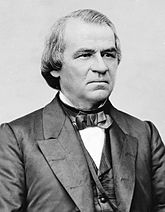
Summary
Positive
Johnson's administration achieved significant successes in foreign affairs, including the purchase of Alaska and the enforcement of the Monroe Doctrine, which marked the emergence of the United States as a continental hegemon.
Negative
Johnson's presidency was marked by a severe constitutional crisis, culminating in his impeachment. His leniency towards former Confederates and opposition to civil rights legislation led to the enactment of Black Codes and a failure to protect the rights of freedmen, polarizing the nation.
Basic Information
| Full Name | Andrew Johnson |
|---|---|
| Party | National Union, Democratic |
| Term | Apr 15, 1865 - Mar 4, 1869 |
| Lifespan | 1808–1875 |
| Vice President(s) | Office vacant |
| Prior Office | 16 Vice President of the United States |
Education
| Degree | Unknown |
|---|---|
| Studies | Unknown |
Election Results
| Election Year(s) | 1864 |
|---|---|
| Primary Opponent(s) | George McClellan |
| Popular Vote | 2218388 (55.02) |
| Electoral Votes | 212 / 233 |
| Voter Turnout | 73.8 |
Andrew Johnson: The Accidental President Who Split a Nation
Andrew Johnson: The Accidental President Who Split a Nation
Andrew Johnson, who became the 17th President of the United States after Abraham Lincoln's assassination, is often remembered more for his controversies than his accomplishments. Undertaking the presidency during one of the most challenging periods in American history, Johnson’s tenure from 1865 to 1869 witnessed the nation struggling to heal after the Civil War.
A Challenging Inheritance
Andrew Johnson assumed the presidency with the monumental task of uniting a fractured nation. The Civil War had ended, but deep divisions remained, especially between Northern and Southern states. Johnson's background as a Southern Unionist added to his complexities; he was viewed with suspicion by the North for his Southern roots while being denounced by the South for his loyalty to the Union.
One of Johnson's most significant challenges was his approach to what would come to be known as Reconstruction—the process of reintegrating Southern states and their populations into the Union. While the Radical Republicans in Congress saw Reconstruction as an opportunity to fundamentally change Southern society—especially with regard to civil rights—Johnson viewed it through a conservative lens. He favored a quick restoration of the Southern states without significant changes to their existing social structures.
Rogue Policies and the Radical Republicans
Johnson’s vision clashed sharply with that of the Radical Republicans, who sought broader civil rights for African Americans and a complete transformation of Southern society. This clash set off a chain of political warfare that enveloped Johnson’s presidency. The most alarming instance of this strife was Johnson's impeachment in 1868—the first time a U.S. president faced this fate.
At the time, Congress passed the Tenure of Office Act, which restricted the president's authority to remove certain officeholders without the Senate's approval. Johnson vehemently objected to this law, believing it unconstitutional. He went ahead and dismissed Secretary of War Edwin Stanton, leading to his impeachment by the House. Although he was ultimately acquitted by the Senate by just one vote, his presidency never recovered from the scandal.
A Tale of Personal Struggles
Understanding Johnson's presidency demands a look at his early life. Born on December 29, 1808, Johnson was a poor tailor's son from North Carolina. He never received formal education, growing up with a desire to rise above his circumstances. His self-taught knowledge is a testament to his determination but also lent him some of his stubbornness and rigidity in political thought.
Despite these early hardships, he climbed the political ladder, first serving as the Mayor of Greeneville, Tennessee, then as a Congressman and eventually the governor of Tennessee before reaching the national stage.
Accomplishments Amidst Controversies
Amidst his many clashes over civil rights and Reconstruction policies, Johnson did manage to achieve some successes in foreign policy. Under Secretary of State William Seward, the U.S. purchased Alaska from Russia for $7.2 million in 1867. This acquisition enriched the nation, expanding its territory and natural resources, often mocked as “Seward’s Folly” at the time. However, it is now seen as a pivotal moment in American expansionism.
Johnson also enforced the Monroe Doctrine, which aimed to deter European interference in the Americas. He pressured France to withdraw its troops from Mexico, which had a significant impact on U.S. foreign policy moving forward.
The Final Years and Legacy
By the time Johnson left office in 1869, his presidency was largely viewed as a failure. His rigid adherence to an outdated political ideology, along with his controversial views on race and governance, alienated many potential allies. His resistance to share power and collaborate with Congress intensified the rift between the executive and legislative branches, deeply affecting the future course of civil rights.
When historians evaluate Andrew Johnson today, he is often among the presidents rated least favorably. His tenure is frequently described as one that exacerbated national discord rather than knitting the country back together. Johnson is a case study in how political misalignment, personal struggle, and a failure to adapt to the evolving challenges of leadership can culminate in a presidency fraught with difficulties.
However, there is some debate about whether Johnson deserves a measure of vindication. After his presidency, he returned to Tennessee, where he rebuilt his political career and was elected back to the U.S. Senate—making him the only former president to serve in the Senate after leaving the White House.
Conclusion: A Cautionary Tale
Andrew Johnson’s life and presidency remind us that leadership in times of crisis requires more than just conviction. It demands a willingness to adapt, build alliances, and embrace change. His story serves as a cautionary tale about the importance of vision and flexibility in governance, especially in an ever-evolving nation.
Key Takeaways
- Johnson's presidency followed Abraham Lincoln’s assassination during a critical period of national healing after the Civil War.
- His rigid views on Reconstruction and race led to significant conflict with Congress, culminating in his impeachment in 1868.
- Despite his failures in civil rights and a tumultuous relationship with Congress, Johnson achieved notable foreign policy successes, including the purchase of Alaska.
- Johnson's presidency is often viewed unfavorably in modern assessments of U.S. history, making him a symbol of the complexities and challenges of leadership during a transformative era.
Keywords
Andrew Johnson, U.S. presidency, Reconstruction, impeachment, Civil War, foreign policy, racism, Radical Republicans
Estimated reading time
8 min
Flesch Reading Ease Score
63