James Buchanan
President #15 • Democratic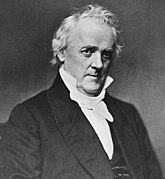
Summary
Positive
Buchanan's presidency is marked by significant legislative and executive activity, including the facilitation of transcontinental communication through the Pacific Telegraph Act, the admission of new states like Minnesota and Oregon, and a successful foreign policy that included the Paraguay Expedition and the establishment of diplomatic relations with Japan.
Negative
Buchanan's presidency is often criticized for its failures, including the disastrous handling of the Lecompton Constitution, the improper lobbying of the Supreme Court in the Dred Scott case, and a policy of inactivity during the secession crisis, which contributed to the disintegration of the Union.
Basic Information
| Full Name | James Buchanan |
|---|---|
| Party | Democratic |
| Term | Mar 4, 1857 - Mar 4, 1861 |
| Lifespan | 1791–1868 |
| Vice President(s) | John C. Breckinridge |
| Prior Office | United States Minister to the Court of St James's ((1853–1856)) |
Education
| Degree | Bachelor's degree |
|---|---|
| Studies | Classical languages, mathematics, moral philosophy, law |
Election Results
| Election Year(s) | 1856 |
|---|---|
| Primary Opponent(s) | John C. Frémont |
| Popular Vote | 1836072 (45.3%) |
| Electoral Votes | 174 / 296 |
| Voter Turnout | 79.4% |
James Buchanan: The Unraveling of a Presidency in Turbulent Times
James Buchanan: The Unraveling of a Presidency in Turbulent Times
James Buchanan served as the 15th president of the United States from 1857 to 1861, during one of the nation’s most tumultuous periods. His presidency is often viewed as a precursor to the Civil War, with many historians attributing the growing sectional conflicts in part to his policies and decisions. However, understanding Buchanan’s presidency requires more than just a cursory glance at its failures; it involves delving into his complex background, his notable achievements, and the controversies that ultimately marred his legacy.
A Life of Public Service
Born on April 23, 1791, in Cove Gap, Pennsylvania, James Buchanan hailed from a humble frontier background. His early education at Dickinson College set a foundation in classical studies, although his rebellious spirit led to expulsion for misconduct before he ultimately graduated with honors. After completing his legal training, Buchanan quickly established himself as a skilled attorney, amassing a small fortune that propelled him into the world of politics and public service.
Buchanan’s political career spanned several decades and included serving as a member of the Pennsylvania House of Representatives, a U.S. Congressman, and Secretary of State under President James K. Polk. It was during these formative years that he evolved from a Federalist into a key figure in the Democratic Party, navigating the shifting political landscape of the time, particularly his loyalty to Andrew Jackson's ideals.
Rising to Power
Buchanan’s long and winding career paved the way for his presidential nomination during the chaotic election of 1856. This election was groundbreaking due to the dissolution of the Whig Party and the rise of the Republican Party. As a staunch supporter of the Union, Buchanan campaigned on a platform emphasizing stability and nationalism, defeating his Republican rival John C. Frémont and winning the presidency with less than half of the popular vote.
The Mandate and Inaugural Address
In his inaugural address, delivered on March 4, 1857, Buchanan sought to maintain national unity amidst rising tensions over slavery. He presented himself as a mediator, arguing that the contentious issue of slavery in the territories should be settled by the Supreme Court rather than legislative action. However, many would later view this as disingenuous, especially given his prior knowledge of the impending Dred Scott decision, which would support pro-slavery interests and inflame northern sentiments.
Domestic Policies: A Dual Legacy of Inaction and Infrastructure
While Buchanan’s presidency is often criticized for its inaction on critical issues such as secession and slavery, it also included notable achievements in domestic policy. One of his significant accomplishments was the Pacific Telegraph Act of 1860, which authorized the construction of a telegraph line connecting the East Coast to the West, modernizing communication and commerce.
Buchanan also managed to admit three new states to the Union — Minnesota, Oregon, and Kansas — although Kansas’s admission was fraught with controversy due to the ongoing violence in “Bleeding Kansas,” fueled by conflicts over whether it would be free or slave territory.
Nevertheless, his response to the Panic of 1857 significantly undermined his administration. Instead of utilizing federal resources to combat the economic downturn, he adhered to stringent Jacksonian policies. His refusal to act alienated northern industrial interests and triggered unrest, leading to the establishment of a coalition that would favor his political opponents.
Foreign Affairs: Ambitious yet Questionable
Buchanan’s foreign policy was characterized by ambitious expansionism, highlighted by his pursuit of American interests in Central America and the Caribbean. He is perhaps best remembered for the Ostend Manifesto, which controversially advocated for the acquisition of Cuba, although this proposal was met with considerable backlash and accusations of increasing pro-slavery sentiment.
His tenure also saw diplomatic successes, such as the Oregon Treaty of 1846, which settled boundary disputes with Britain, and the Mexico-American War Treaty, which ceded extensive territories to the U.S. However, these achievements were overshadowed by the divisive nature of his policies and the rising sectional tensions between the North and South.
The Crumbling of Unity and Presidency
As the 1860 election approached, Buchanan’s inability to unite the nation was evident. His administration faced increasing criticism, and the Democratic Party was fractured between Northern and Southern factions. As southern states began to secede following Lincoln’s election, Buchanan famously declared that while secession was illegal, the federal government had no constitutional authority to intervene. This passive stance effectively allowed the Confederacy to gain momentum, positioning the nation on a direct path to civil war.
Controversies and Scandals
Buchanan's presidency was marred by significant controversies, including allegations of corruption and the notorious Covode Committee investigation, which exposed widespread patronage and cronyism within his administration. These revelations not only damaged his credibility but also cast a shadow over his legacy as he failed to adequately address issues of integrity that plagued his administration.
The Aftermath and Legacy
In the end, James Buchanan’s presidency serves as a powerful reminder that experience alone isn’t sufficient for effective leadership. His flawed understanding of the political landscape and refusal to confront the impending disaster of civil war curtailed any chance of averting conflict. After leaving office, he retired to Pennsylvania, continuing to defend his decisions until his death in 1868.
Buchanan remains a polarizing figure in American history, often regarded as one of the country’s most ineffective presidents, his tenure a cautionary tale of what happens when a leader fails to lead decisively amidst crisis. The lessons from his legacy continue to resonate in discussions about leadership, governance, and accountability in times of national distress.