Franklin Pierce
President #14 • Democratic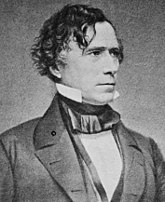
Summary
Positive
Pierce's presidency is noted for the Gadsden Purchase, which resolved border disputes with Mexico and facilitated future national infrastructure. His administration also contributed to the professionalization of the federal bureaucracy and expanded American commercial interests through treaties with Japan and Canada.
Negative
Pierce's presidency is often criticized for the Kansas-Nebraska Act, which repealed the Missouri Compromise and accelerated the sectional conflict leading to the Civil War. His handling of the Kansas Territory and the Ostend Manifesto further damaged his reputation and the credibility of the federal government.
Basic Information
| Full Name | Franklin Pierce |
|---|---|
| Party | Democratic |
| Term | Mar 4, 1853 - Mar 4, 1857 |
| Lifespan | 1804–1869 |
| Vice President(s) | William R. King, (Died in office April 18, 1853, Office vacant) |
| Prior Office | Brigadier General of the 9 Infantry, United States Army ((1847–1848)) |
Education
| Degree | Bachelor's degree |
|---|---|
| Studies | Law |
Election Results
| Election Year(s) | 1852 |
|---|---|
| Primary Opponent(s) | Winfield Scott |
Franklin Pierce: A Presidency Marked by Ambition and Controversy
Franklin Pierce: A Presidency Marked by Ambition and Controversy
Franklin Pierce served as the 14th president of the United States from 1853 to 1857, presiding over a nation teetering on the edge of civil war. Known for his attempts at expansion and unity, he is often remembered more for the controversies his administration ignited than for its achievements. In this article, we'll explore his background, key policies, achievements, and the controversies that shaped his legacy.
A Promising Start
Franklin Pierce was born on November 23, 1804, in Hillsborough, New Hampshire, to a politically active family. His father served in the Revolutionary War, and Pierce’s early life in this environment naturally drew him toward politics. After attending Bowdoin College, where he almost graduated at the bottom of his class due to an early lack of focus, he eventually found his footing and earned a reputation as a capable lawyer.
Pierce's military background also played a significant role in his political ascent. He served bravely in the Mexican-American War and returned a war hero, which helped bolster his credentials for the presidency. By 1852, after a quick rise through several political offices, including U.S. Senator and U.S. Representative, he emerged as a “dark horse” candidate for the Democratic nomination, ultimately winning against well-known opponents in a contentious convention.
A Mixed Mandate
Pierce took office believing he had a clear mandate for his policies. His presidency aimed to calm growing sectional tensions and promote the expansion of the U.S. territory under the philosophy of “Manifest Destiny,” which was a widely held belief that the United States was destined to expand across the North American continent. However, tragedy had struck just before his inauguration when his young son was killed in a train accident. This personal loss overshadowed his presidency and may have contributed to his often indecisive leadership style.
Tensions Over Slavery
The most defining aspect of Pierce’s presidency was his handling of the issue of slavery. He supported the Kansas-Nebraska Act, which allowed residents of those territories to decide whether they would allow slavery through a concept called “popular sovereignty.” This law effectively repealed the Missouri Compromise of 1820, which had kept the peace by establishing a line separating free and slave states.
The Kansas-Nebraska Act led to violent conflicts in those territories, known as “Bleeding Kansas,” where pro-slavery and anti-slavery forces clashed violently. Pierce's response to this turmoil was criticized as biased, favoring pro-slavery interests, which only deepened the divisions between North and South and damaged his reputation.
A Struggling Administration
Despite his ambitions, Pierce's administration faced numerous challenges. His support for the Fugitive Slave Act alienated many Northern Democrats, while Southern Democrats criticized him for his lack of aggression on slavery-related issues. His administration became increasingly isolated and struggled to maintain cooperation with Congress, leading to significant political fallout.
Additionally, the Ostend Manifesto, a failed diplomatic attempt to acquire Cuba, further tarnished his presidency. The document suggested that if Spain refused to sell Cuba, the U.S. had the right to take it by force — a position that was met with outrage in the North and further diminished his standing.
Legislative Triumphs and Setbacks
Despite the controversies, Pierce’s presidency did see some notable achievements:
- Gadsden Purchase (1853): This acquisition of territory from Mexico expanded the U.S. to include parts of present-day Arizona and New Mexico, facilitating the construction of a southern transcontinental railroad.
- Opening of Japan: Pierce’s administration played a critical role in ending Japan’s isolationist policies, paving the way for trade and diplomacy.
- Infrastructure Developments: Although he was reluctant to expand federal spending on internal improvements, his administration did bolster the national infrastructure through the Guano Islands Act, which allowed Americans to claim uninhabited territories for resource extraction.
However, his administration's legacy is often viewed through a lens of failure, particularly with how it dealt with the escalating tensions over slavery. By the 1856 election, Pierce was not renominated by his own party, marking a significant downfall as he became the first sitting president to be denied the party's nomination despite his desire to continue.
Concluding Reflections
Franklin Pierce’s presidency is a tale of ambition marred by controversy and mismanagement. His efforts to balance sectional interests and pursue his vision of expansion ultimately failed, leading to greater polarization and paving the way for the Civil War. While he made strides in foreign diplomacy and territorial expansion, his inability to unify the nation around the divisive issue of slavery overshadowed any accomplishments.
Ultimately, Pierce becomes a cautionary tale in American history — a reminder of the fragile nature of political compromise in a deeply divided nation.
Key Takeaways
- Franklin Pierce was the 14th President of the United States, serving from 1853 to 1857.
- His presidency was marked by significant events like the Kansas-Nebraska Act, which intensified national disputes over slavery.
- Personal tragedy impacted his leadership style and effectiveness, hindering his presidency.
- Pierce's administration is remembered more for its controversies and failures than its achievements, serving as a warning about the dangers of political division.
Keywords
Franklin Pierce, 14th President, Kansas-Nebraska Act, Bleeding Kansas, Gadsden Purchase, Ostend Manifesto, slavery, Civil War
Estimated Reading Time
7 min