Millard Fillmore
President #13 • Whig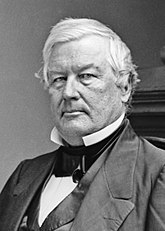
Summary
Positive
Millard Fillmore's presidency is marked by significant achievements such as the Compromise of 1850, which aimed to preserve the Union during a time of crisis, the opening of Japan to American trade, and the modernization of the American currency system. His administration also established the federal land-grant system for infrastructure, contributing to economic modernization and stability.
Negative
Fillmore's legacy is marred by his enforcement of the Fugitive Slave Act, which denied rights to accused runaway slaves and compelled citizens to assist in their capture. This law alienated many in the North and radicalized the abolitionist movement, ultimately contributing to the sectional tensions that led to the Civil War. His rigid adherence to legalism prevented him from addressing the moral crises of his time.
Basic Information
| Full Name | Millard Fillmore |
|---|---|
| Party | Whig |
| Term | Jul 9, 1850 - Mar 4, 1853 |
| Lifespan | 1800–1874 |
| Vice President(s) | Office vacant |
| Prior Office | 12 Vice President of the United States |
Education
| Degree | Unknown |
|---|---|
| Studies | Unknown |
Election Results
| Election Year(s) | 1848 |
|---|---|
| Primary Opponent(s) | Lewis Cass |
| Popular Vote | 1361393 (47.3) |
| Electoral Votes | 163 / 303 |
Millard Fillmore: The Overlooked President Who Tried to Hold a Nation Together
Millard Fillmore: The Overlooked President Who Tried to Hold a Nation Together
Millard Fillmore, the 13th President of the United States, often finds himself overshadowed by his more famous predecessors and successors. Serving from 1850 to 1853, his presidency occurred during a chaotic era of American history, marked by divisive debates over slavery and sectionalism. But beneath the surface of his often-forgotten tenure lay some significant achievements and equally significant failures that shaped the country to come.
Early Life: From Modest Beginnings to Political Aspirations
Born on January 7, 1800, in a log cabin in New York, Fillmore was one of eight children in a struggling family of tenant farmers. Life was harsh, and the need for financial security propelled him to seek a better future. Despite limited formal education, he was determined to educate himself, often borrowing books and reading during his long hours as an apprentice to a clothmaker.
Through hard work and diligence, Fillmore eventually gained enough standing to enter the legal profession, becoming a successful lawyer. His rise through the ranks of New York politics began with his association with the Anti-Masonic Party, where he garnered attention as a staunch advocate against secret societies. This involvement led to his election to the New York State Assembly and later the U.S. House of Representatives, solidifying his reputation in politics.
The Path to Presidency
Fillmore was named the vice president under Zachary Taylor in 1848. After Taylor's sudden death in 1850, Fillmore ascended to the presidency under the constitutional succession clause. However, this unique rise meant that he never faced the electorate directly, shaping his cautious and often defensive approach to governance.
His administration was defined largely by the Compromise of 1850, a series of legislative measures aimed at resolving tensions over slavery and territorial expansion. Fillmore viewed the compromise as a critical, albeit temporary, solution to the nation's divisive issues.
Major Accomplishments: Legislative and Diplomatic Efforts
Despite being labeled as a transitional figure between more charismatic presidents, Fillmore's administration was not without notable achievements:
-
The Compromise of 1850: A significant legislative triumph, Fillmore signed the Compromise which admitted California as a free state and established territories with popular sovereignty regarding the issue of slavery. This momentarily appeased both pro- and anti-slavery factions, showcasing his commitment to maintaining the Union.
-
Opening Japan: Fillmore is credited with opening trade relations with Japan by authorizing Commodore Matthew Perry's expedition. Perry's mission culminated in the Treaty of Kanagawa in 1854, which marked the beginning of Japan's engagement with the Western world.
-
Economic Modernization: Fillmore enacted several economic reforms, including the Coinage Act of 1853, which adjusted the nation's monetary system. This act responded to the economic demands of the growing nation, addressing issues of currency and trade.
-
Federal Support for Railroads: He signed the first federal land grant for railroad construction, contributing to the development of transportation infrastructure crucial for expanding the economy and national unity.
Controversies: The Fugitive Slave Act and Political Failures
While Fillmore's presidency had its achievements, it was also marred by controversies that would define his legacy:
-
The Fugitive Slave Act: Arguably Fillmore's most significant failure, this law mandated strict enforcement of returning escaped slaves to their owners, even compelling citizens to assist in their capture. Though he personally opposed slavery, Fillmore believed in upholding the Constitution at all costs, which alienated many in the North and escalated tensions leading to the Civil War.
-
Internal Party Conflict: Fillmore's presidency often faced turmoil within the Whig Party, particularly between more radical members who sought to take a firm stand against slavery and the more moderate, conservative faction he represented. His decision to remove anti-Compromise members from the cabinet further deepened divisions, ultimately contributing to the party's dissolution.
The Legacy of Millard Fillmore
After leaving office in 1853, Fillmore was largely forgotten, a stark contrast to the turmoil and character of the times he governed. His post-presidency years did not see a return to political power, but he did reflect on his presidency and attempted to re-enter the political arena in 1856 as a candidate for the Know-Nothing Party.
Ultimately, Fillmore's presidency teaches a valuable lesson about the complexities of leadership during a time of moral crisis. Despite his management approach targeting compromise and stability, his rigid adherence to constitutional provisions led to indelible marks on both his legacy and the nation, reflecting the tenuous balance between governance and ethics.
Conclusion: A Man of His Times
Millard Fillmore remains historically significant as a leader who straddled a tumultuous period in American history. He aimed to navigate the country through crises with legislative finesse and modern economic strategies. However, his presidency serves as a cautionary tale about the limits of compromise during times of ethical turmoil, illustrating how the middle ground can sometimes lead to the most dangerous cliffs. Today, Fillmore's mixed legacy invites reflection on the ongoing struggle for civil rights and the challenges of leadership in times of division.