James Knox Polk
President #11 • Democratic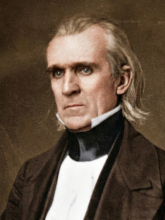
Summary
Positive
Polk's presidency is marked by significant territorial expansion, including the acquisition of over one million square miles of land, the establishment of the Independent Treasury, and the reduction of trade barriers, which collectively transformed the United States into a continental power.
Negative
Polk's administration is criticized for its aggressive war against Mexico, which many view as unjust, and for exacerbating sectional tensions over slavery, ultimately contributing to the fracturing of the Union.
Basic Information
| Full Name | James Knox Polk |
|---|---|
| Party | Democratic |
| Term | Mar 4, 1845 - Mar 4, 1849 |
| Lifespan | 1795–1849 |
| Vice President(s) | George M. Dallas |
| Prior Office | 9 Governor of Tennessee ((1839–1841)) |
Education
| Degree | Bachelor's |
|---|---|
| Studies | Mathematics and Classics |
Election Results
| Election Year(s) | 1844 |
|---|---|
| Primary Opponent(s) | Henry Clay |
| Popular Vote | 1339494 (49.54%) |
| Electoral Votes | 170 / 275 |
| Voter Turnout | 78.9% |
James K. Polk: The Fearless President Who Changed America Forever
James K. Polk: The Fearless President Who Changed America Forever
James K. Polk served as the 11th President of the United States from 1845 to 1849, leading a transformative tenure often characterized by ambition, decisiveness, and a legacy that remains complex and contentious to this day. Standing at the right juncture of history, Polk expanded the nation’s territory significantly, propelling the United States from the Atlantic to the Pacific. This article explores the life, presidency, achievements, and controversies of James K. Polk, shedding light on one of the most fascinating figures in American political history.
A Bold Beginning
Born on November 2, 1795, in Mecklenburg County, North Carolina, Polk was the oldest of ten children in a farming family. His early years were marked by hardship, as he suffered from a debilitating illness that required a painful surgery at age 17. Yet, this personal trial forged a resilience in Polk that shaped his formidable career. He went on to study at the University of North Carolina, excelling academically and entering politics in Tennessee, where he became known as “Young Hickory,” a nod to his admiration for fellow president Andrew Jackson.
The Political Rise
Polk’s political journey took him from local politics to the U.S. House of Representatives, where he quickly gained the attention of President Jackson. As a congressman, he earned a reputation for his steadfast support of Jacksonian principles, particularly in opposition to the Second Bank of the United States. After serving as Speaker of the House, he sought to regain ground for the Democrats in Tennessee as Governor but faced challenges—losing key elections that seemed to signal the end of his political future. However, fate would have it that he emerged as a surprising candidate for the presidency in 1844.
The Election of 1844: A Turning Point
The 1844 election was pivotal, marking a shift from economic debates to the contentious issue of territorial expansion. Polk, seen as a dark horse candidate who emerged amid party factions, seized on the issue of Manifest Destiny—the belief that the U.S. was destined to spread across the continent. His campaign promised to re-occupy Oregon and annex Texas, uniting disparate factions of the Democratic Party. Polk’s narrow victory over Whig candidate Henry Clay was a watershed moment, emphasizing the nation’s leanings toward expansionism.
Achievements and Policies
Once in office, Polk pursued his vision with fervor, laying out what he termed his “Four Great Measures”:
- Reduction of Tariffs: Polk oversaw significant decreases in tariffs, boosting trade and benefiting the economy.
- Independent Treasury: He established a system to manage federal funds independently from private banks, ensuring fiscal stability.
- Oregon Territory: Polk negotiated the Oregon Treaty with Great Britain, securing the Pacific Northwest without conflict, a masterstroke of diplomacy.
- Acquisition of California and New Mexico: This ambition led to the Mexican-American War, during which the U.S. secured vast new territories.
Despite these accomplishments, the methods employed to achieve them raised serious ethical concerns—particularly the war with Mexico, which many labeled as an unjust conflict to instate American dominance. This war sparked fierce opposition, notably from Whigs and even some Democrats, including a young Abraham Lincoln, who famously questioned Polk’s justifications for war.
Controversies and Legacy
Polk's presidency was not without significant controversy. He faced backlash for:
- Launching the Mexican-American War, viewed as an act of aggression that inflamed tensions regarding slavery and set a dangerous precedent for Presidential war-making power.
- His secretive purchases of enslaved individuals, which revealed a stark contrast between his public persona and personal dealings.
- Failure to address the brewing conflict over slavery that arose from newly acquired territories, which contributed to sectional tensions leading toward the Civil War.
Despite these controversies, there are those who regard Polk as one of the most effective presidents due to his unwavering dedication to fulfilling his stated goals.
Conclusion: A Complex Legacy
Polk's presidency ushered in a new era of American expansion and economic growth but did so at a high moral cost. He passed away shortly after leaving the White House, having exhausted himself in pursuit of his ambitious agenda. Historians continue to grapple with the duality of his legacy: a president whose deft maneuvering fundamentally altered the nation, while also sowing the seeds for future discord.
In retrospect, James K. Polk’s story is a striking reminder of the complexities of leadership and the intricate balance between ambition and consequence.
Key Takeaways:
- Polk expanded U.S. territory significantly by implementing aggressive foreign policies.
- His presidency highlighted the tension between nationalism and the ethical implications of slavery.
- Polk is often seen as one of the most effective single-term presidents in history, achieving all his major goals but at a high moral cost.
- His legacy is marked by both triumphant territorial gains and the deepening divisions that led to the Civil War.